
AI Economics is a Design Problem
The companies most likely to win in today's AI economy will manage one number: cost per outcome.

AI Economics is a Design Problem

The companies most likely to win in today's AI economy will manage one number: cost per outcome.
AI

No items found.

Copy page URL to clipboard

Share on X

Share on LinkedIn

https://www.iconiqcapital.com/growth/insights/ai-economics-is-a-design-problem

Stay Ahead with ICONIQ
Loading the Elevenlabs Text to Speech AudioNative Player...

We observed three questions that have run the AI conversation through the first half of 2026. Is adoption generating ROI? Should companies push usage or cap it? Will open-source models replace the frontier?

Each one starts too far downstream. We believe the more useful management question is: What combination of people, software, and models can produce the required result at the right level of quality and the lowest sustainable cost?

For the 2026 State of AI report, we surveyed roughly 300 executives at software companies building AI products, interviewed finance leaders who own AI budgets, and studied what companies actually pay for. Our conclusion is that AI economics is an operating-design problem before it is a spend-management problem. Tokens, licenses, and benchmark scores are inputs; the unit of value is the workflow outcome.

Companies should identify the workflows AI can materially redesign, set the quality and risk bar, and only then optimize the mix of labor, software, and models. A token cap or model preference should never come first.

AI activity is high. Deep use is rare.

The gap between AI pilots and measurable P&L impact is generally familiar by now.  Many pilots begin with a horizontal tool and a broad mandate to "use AI." The result is often activity without any change in how work moves through the company.

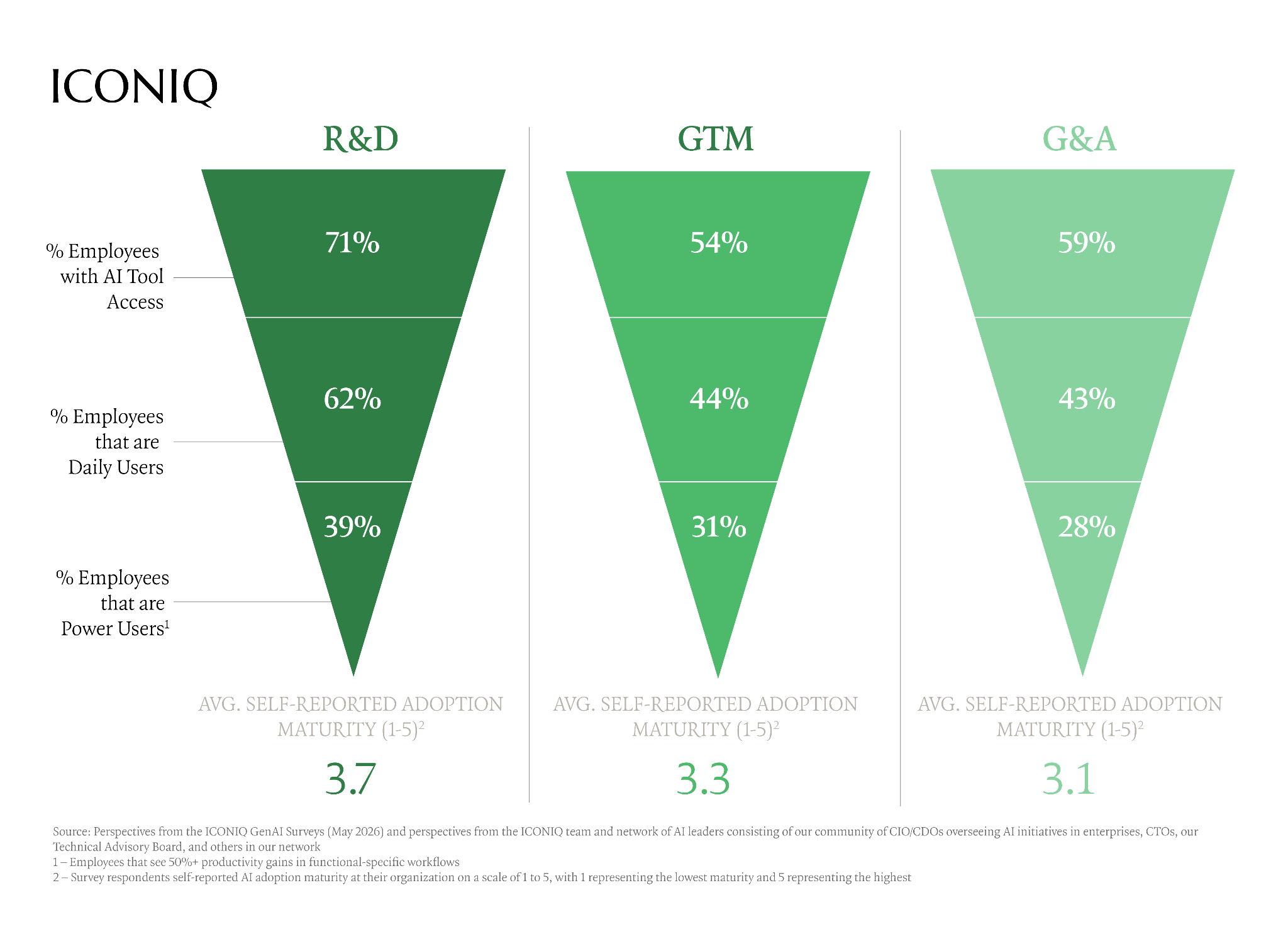
Our survey also shows the same gap. At the companies we surveyed, 71% of R&D employees have access to AI tools, 62% use them daily, and only 39% are power users. The drop-off is steeper in sales, marketing, and corporate functions. Most companies have bought AI access. Fewer have established deep, repeatable use.
More usage is not automatically more valuable. Once AI is widely available, employees default to it even for work where it adds a step rather than removing one. An AI-generated first draft still gets rewritten. A human repeats the analysis to verify the output. Two teams may unknowingly use AI to solve the same problem.   And when relevant context is scattered across CRM, ERP, ticketing, knowledge-management, and communication systems, employees can spend more time finding, copying, and reconciling information than the AI ultimately saves.

These costs often stay hidden because they rarely appear in the AI budget. They show up as rework, duplicate effort, extra review, slower handoffs, and inconsistent decisions. A task finished faster in one application can still make the end-to-end process slower.

This creates two distinct failure modes: too little experimentation to find valuable use cases, and indiscriminate use that layers AI onto existing work without removing anything. Companies need to give employees enough freedom, and enough spend, to test new approaches and find where AI changes the work. But they also need to watch the full workflow and separate AI that eliminates effort and AI that merely shifts or duplicates it.

That is why the cost often appears before the ROI does. A license or API bill can be counted immediately. Time saved, faster cycle times, better conversion, or lower support costs may only become visible when a company changes the workflow, sets a baseline, and identifies the business metric that should shift.

In our view, some of the best candidates for redesign share four traits. The work is high-volume and repeatable, with digital inputs and outputs. It has a clear quality threshold and an observable business result. It is constrained by queues, handoffs, or routine review rather than by irreplaceable judgment. And it carries enough economic weight to justify the integration, monitoring, and change management that redesign requires.

For those types of workflows, AI can become the default path and human staffing the exception. For ambiguous, low-frequency work, a copilot may still improve individual productivity, but it should not carry the same ROI expectations (at least for now).

Ramp's Deal Desk is a good example. A 2-person team runs it, managing thousands of contracts per month for 600+ sellers at a business with over 70,000 customers. The team has redesigned the core workflows so AI handles the standard path: intake, pricing, other terms, document generation, and signature routing. This allows the operators to focus on the small subset of deals that require judgment -- complex negotiations, custom terms, and more.

The lesson is to give teams room to find where AI changes the work, then concentrate investment on the workflows where automation can remove the most human touch and handoffs while preserving quality. In practice, that could look like a short, time-boxed workflow review once a use case shows repeated demand: establish a baseline for volume, cycle time, rework, and cost; map the steps and handoffs; define the quality bar and exception rules; then pilot the redesigned process against the baseline. Workflows that show a material improvement earn deeper integration and change-management resources; those that do not remain lightweight copilots or are retired.

Metering token spend is managing the wrong number

According to Ramp's business spend data, the top 1% of companies spend about $7,500 per employee per month on AI. The top 10% spend about $630. The median company spends just $12.
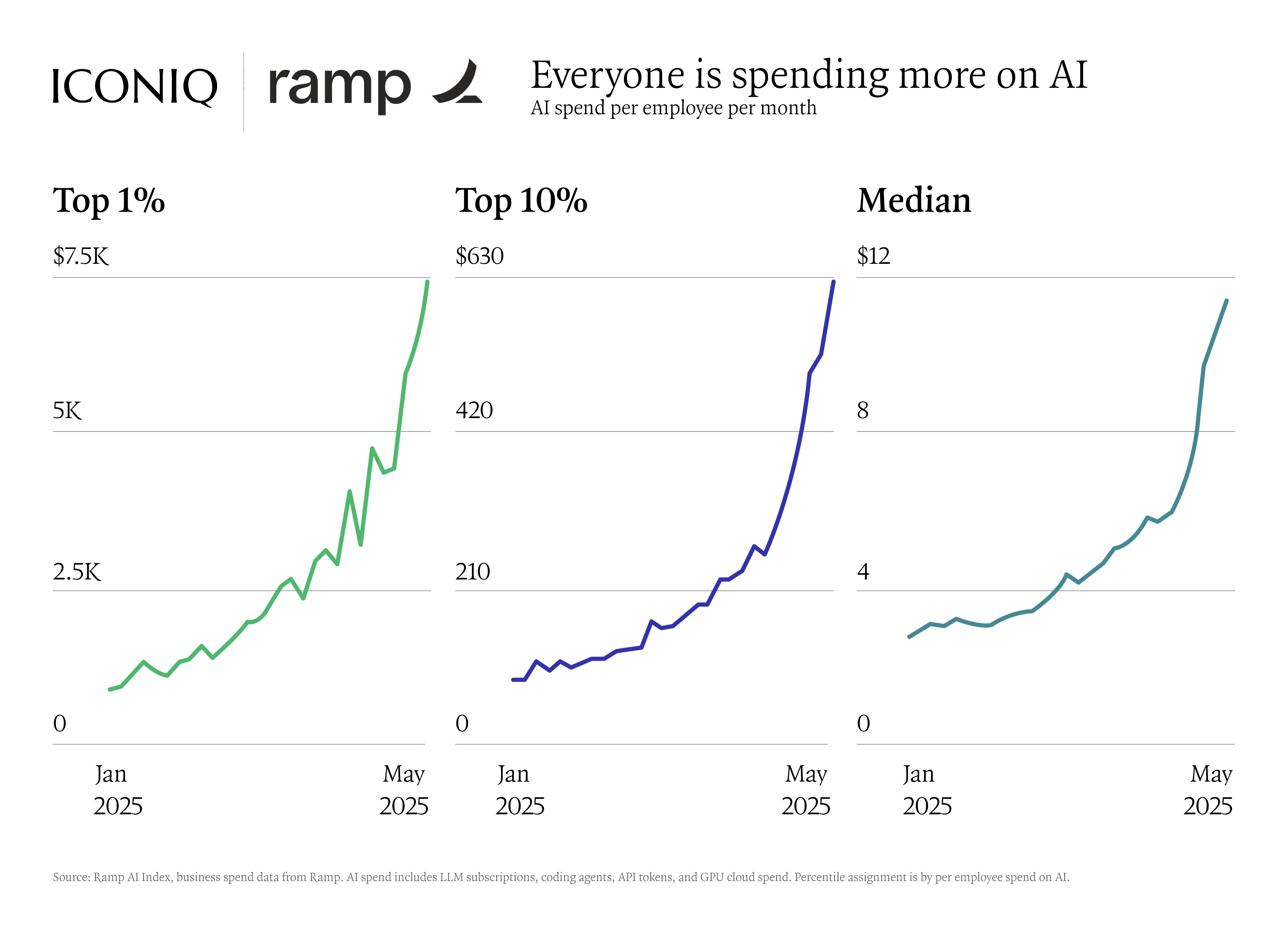
That spread does not tell us which company is better managed. It tells us that companies are operating different workflows, at different levels of maturity, and with vastly different outcome economics. In our view, an average per-employee target would be mostly meaningless.

The current debate generally treats token use as either evidence of ambition or as a cost to suppress. Both are weak proxies. Token counts are easy to meter, but they do not tell a manager whether the company approved more contracts, resolved more cases, shipped better software, or closed its books faster.

Metering still matters. Models are variable-cost infrastructure, multi-step agentic workflows can burn 5 to 30 times as many tokens as a simple chat exchange, and 68% of the builders we surveyed said the true cost of internal AI is very or moderately difficult to predict. But metering is necessary plumbing. A cap can prevent a runaway bill; it cannot determine which workflows deserve investment.

Our survey also shows how sharply usage scales with company size. Only 30% of companies with 50 or fewer employees spend $50,000 or more a month on internal AI tokens. Among companies with 1,000 or more employees, 36% spend $1 million or more, and 14% that spend more than $5 million.
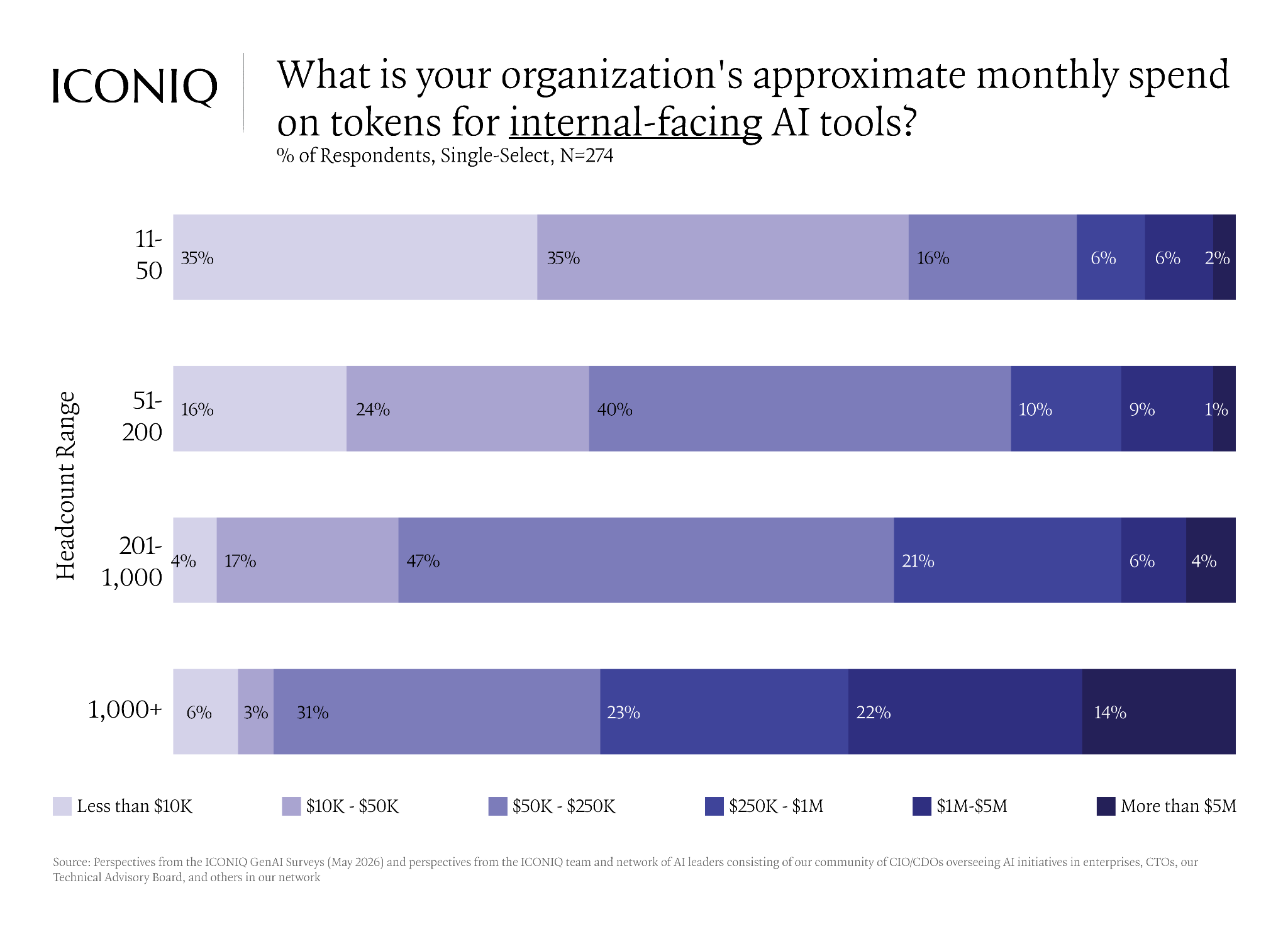
Monthly token spend rises sharply with company size. Source: ICONIQ 2026 State of AI, N=274.

Generally, more disciplined companies separate activity from value. Token counts are easy to measure, but they become a poor target the moment teams are rewarded for maximizing them. Stronger systems charge AI usage back to cost centers and connect it to outcomes such as features shipped, cases resolved, or cycle time reduced. One early-stage company gives engineers unlimited tokens, but holds managers accountable for three to five times the productivity in return.

Model choice follows the workflow

Once the workflow and quality bar are defined, the open-versus-frontier debate becomes a routing decision rather than a company-wide ideology.

Frontier models dominate enterprise wallet share. In our latest survey, 82% of companies surveyed use Anthropic and 71% use OpenAI, compared with roughly 4% to 7% using open-source models from DeepSeek and Moonshot AI.
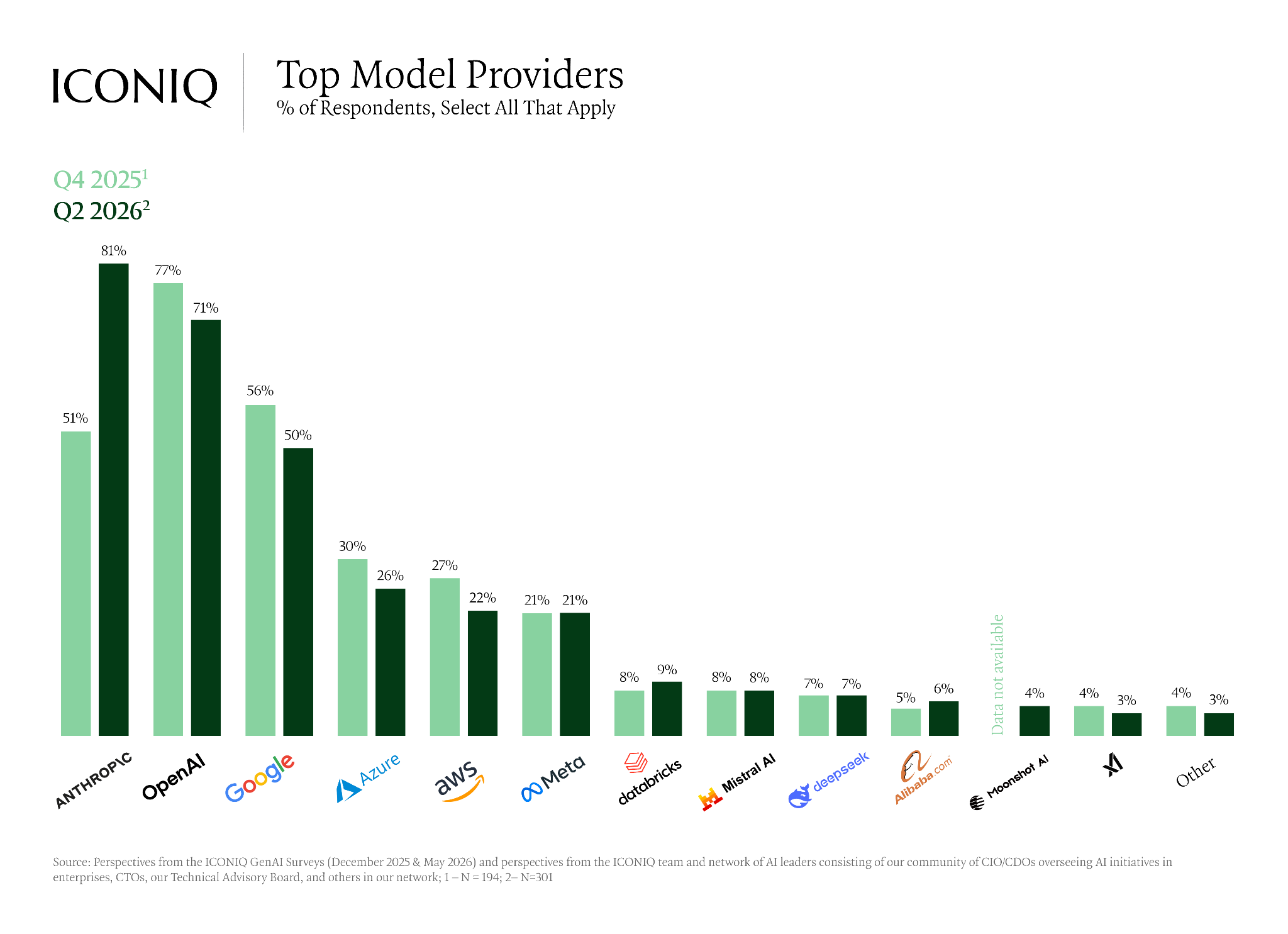
Frontier providers lead enterprise adoption, while companies continue to add model providers. Source: ICONIQ 2026 State of AI.

At the same time, the average number of model providers per company rose from about 3.1 to 3.3 in the last six months and most builders use a combination of closed and open-source models. New releases, including Moonshot AI’s Kimi, alongside models from DeepSeek, Qwen, Mistral, and others, are expanding the range of tasks that can be served by lower-cost or customizable alternatives.

Running more providers is deliberate portfolio architecture. The rule is simple: use the lowest-cost model that reliably clears the quality bar for a task, and escalate only when the added capability is worth more than the added cost.

The resulting architecture is a barbell. Open, customized, or lower-cost models handle routine, high-volume work; frontier models handle complex reasoning, exceptions, and high-stakes decisions. Open source models tend to win volume. Frontier models often win premium work.

One operating envelope for people, software, and models

Today, many companies budget headcount, software, and model usage separately. However, work does not happen separately.

Optimizing those line items independently can make the total system worse: cap model usage and add manual reviewers; cut a software tool and create more coordination work; freeze headcount and buy technology without redesigning the process.

AI pushes teams toward a different unit of management: cost per outcome. A deal-desk leader, for example, should own the total cost of moving a contract from submission to compliant approval at an agreed turnaround time. Within that envelope, the team can rebalance among reviewers, workflow software, and model usage.

That envelope must include the costs that line-item budgets hide: rework, escalations, latency, human oversight, vendor concentration, security, and change management. The cheapest model is not cheaper if it creates more reviews; software is not efficient if it adds another layer without removing work; and headcount is not necessarily more flexible when volume is volatile.

Governance changes too. Finance sets the envelope and return hurdle; workflow owners own quality, service levels, and cost per outcome; platform teams provide routing, observability, and security. AI becomes part of the operating budget, not a special pool.

Coinbase has described the direction of travel. It has said it cut AI spend in half while token usage continued to grow, using routing, caching, and lower-cost open models as defaults. The lesson is not to minimize tokens. It is to engineer the system so more useful work fits inside the same or a lower operating envelope.

Fund discovery and budget outcomes

We believe the answer collapses the three debates into one operating model. Let teams explore widely enough to find valuable patterns, then redesign and fund the workflows that prove out. Discovery and discipline work together.

Give people room to experiment, compare tools, and surface repeatable patterns. Graduate the strongest patterns into workflows with scale, clear rules, measurable outcomes, and handoffs worth removing. Redesign those end to end, put people on the exceptions and the judgment, and hold the team to one envelope across headcount, software, and models. Route each task to the lowest-cost model that clears the quality and risk bar.

By 2027, we believe AI advantage will not come from spending the most or capping the hardest. It will come from operational clarity: knowing which work to redesign, what the outcome must achieve, and how to allocate people, software, and models to deliver it at the lowest sustainable cost.

No items found.
The ICONIQ Venture and Growth website does not present information relating to ICONIQ, its investment funds, or its advisory business and should not be consulted for any advisory purposes. The ICONIQ Venture and Growth content is intended for the use of company founders and executives.

Notes

Disclaimer

The views expressed in this presentation are those of ICONIQ Venture & Growth ("ICONIQ" or the "firm"), are the result of proprietary research, may be subjective, and may not be relied upon in making an investment decision. 

 This presentation is for general information purposes only and does not constitute investment advice.  This presentation must not be relied upon in connection with any investment decision.  The information in this presentation is not intended to and does not constitute financial, accounting, tax, legal, investment, consulting or other professional advice or services.  Nothing in this presentation is or should be construed as an offer, invitation or solicitation to engage in any investment activity or transaction, including an offer to sell or a solicitation of an offer to buy any securities which should only be made pursuant to definitive offering documents and subscription agreements, including without limitation, any investment fund or investment product referenced herein.  

Any reproduction or distribution of this presentation in whole or in part, or the disclosure of any of its contents, without the prior consent of ICONIQ, is strictly unauthorized.  

This presentation may contain forward-looking statements based on current plans, estimates and projections.  The recipient of this presentation ("you") are cautioned that a number of important factors could cause actual results or outcomes to differ materially from those expressed in, or implied by, the forward-looking statements.  The numbers, figures and case studies included in this presentation have been included for purposes of illustration only, and no assurance can be given that the actual results of ICONIQ or any of its partners and affiliates will correspond with the results contemplated in the presentation.  No information is contained herein with respect to conflicts of interest, which may be significant.  The portfolio companies and other parties mentioned herein may reflect a selective list of the prior investments made by ICONIQ.  

Certain of the economic and market information contained herein may have been obtained from published sources and/or prepared by other parties.  While such sources are believed to be reliable, none of ICONIQ or any of its affiliates and partners, employees and representatives assume any responsibility for the accuracy of such information.  

All of the information in the presentation is presented as of the date made available to you (except as otherwise specified), and is subject to change without notice, and may not be current or may have changed (possibly materially) between the date made available to you and the date actually received or reviewed by you.  ICONIQ assumes no obligation to update or otherwise revise any information, projections, forecasts or estimates contained in the presentation, including any revisions to reflect changes in economic or market conditions or other circumstances arising after the date the items were made available to you or to reflect the occurrence of unanticipated events.  

For avoidance of doubt, ICONIQ is not acting as an adviser or fiduciary in any respect in connection with providing this presentation and no relationship shall arise between you and ICONIQ as a result of this presentation being made available to you.  

ICONIQ is a diversified financial services firm and has direct client relationships with persons that may become limited partners of ICONIQ funds.  Notwithstanding that a person may be referred to herein as a "client" of the firm, no limited partner of any fund will, in its capacity as such, be a client of ICONIQ.  There can be no assurance that the investments made by any ICONIQ fund will be profitable or will equal the performance of prior investments made by persons described in this presentation. 

Any information in this presentation is directed at, and intended for, only persons who are experienced institutional or professional investors (“professional investors”) as defined by applicable law and regulation.  Any person that is not a professional investor is not an intended recipient of this presentation and the matters discussed herein.

ICONIQ is a trading name of certain ICONIQ Partners (UK) LLP. ICONIQ Partners (UK) LLP (Registration Number: 973080) is an appointed representative of Kroll Securities Ltd. (Registration Number: 466588) which is authorised and regulated by the Financial Conduct Authority. ICONIQ Partners (UK) LLP is a limited liability partnership whose members are ICONIQ Capital (UK) Ltd, Seth Pierrepont and Lou Thorne, and it is registered in England and Wales and has its registered office at 127 Charing Cross Road, 5th Floor, London, WC2H 0EW. ICONIQ Partners (UK) LLP acts as an adviser to ICONIQ Capital LLC.

Unless otherwise indicated, the views expressed in this presentation are those of ICONIQ Venture and Growth (“ICONIQ" or the “Firm"), are the result of proprietary research, may be subjective, and may not be relied upon in making an investment decision. Information used in this presentation was obtained from numerous sources. Certain of these companies are portfolio companies of ICONIQ Venture and Growth. ICONIQ Venture and Growth does not make any representations or warranties as to the accuracy of the information obtained from these sources.

This presentation is for general information purposes only and does not constitute investment advice. This presentation must not be relied upon in connection with any investment decision. The information in this presentation is not intended to and does not constitute financial, accounting, tax, legal, investment, consulting or other professional advice or services. Nothing in this presentation is or should be construed as an offer, invitation or solicitation to engage in any investment activity or transaction, including an offer to sell or a solicitation of an offer to buy any securities which should only be made pursuant to definitive offering documents and subscription agreements, including without limitation, any investment fund or investment product referenced herein.

Any reproduction or distribution of this presentation in whole or in part, or the disclosure of any of its contents, without the prior consent of ICONIQ, is strictly unauthorized.

This presentation may contain forward-looking statements based on current plans, estimates and projections. The recipient of this presentation ("you") are cautioned that a number of important factors could cause actual results or outcomes to differ materially from those expressed in, or implied by, the forward-looking statements. The numbers, figures and case studies included in this presentation have been included for purposes of illustration only, and no assurance can be given that the actual results of ICONIQ or any of its partners and affiliates will correspond with the results contemplated in the presentation. No information is contained herein with respect to conflicts of interest, which may be significant. The portfolio companies and other parties mentioned herein may reflect a selective list of the prior investments made by ICONIQ.

Certain of the economic and market information contained herein may have been obtained from published sources and/or prepared by other parties. While such sources are believed to be reliable, none of ICONIQ or any of its affiliates and partners, employees and representatives assume any responsibility for the accuracy of such information.

All of the information in the presentation is presented as of the date made available to you (except as otherwise specified), and is subject to change without notice, and may not be current or may have changed (possibly materially) between the date made available to you and the date actually received or reviewed by you. ICONIQ assumes no obligation to update or otherwise revise any information, projections, forecasts or estimates contained in the presentation, including any revisions to reflect changes in economic or market conditions or other circumstances arising after the date the items were made available to you or to reflect the occurrence of unanticipated events. Numbers or amounts herein may increase or decrease as a result of currency fluctuations.

For avoidance of doubt, ICONIQ is not acting as an adviser or fiduciary in any respect in connection with providing this presentation and no relationship shall arise between you and ICONIQ as a result of this presentation being made available to you.

ICONIQ is a diversified financial services firm and has direct client relationships with persons that may become limited partners of ICONIQ funds. Notwithstanding that a person may be referred to herein as a "client" of the firm, no limited partner of any fund will, in its capacity as such, be a client of ICONIQ. There can be no assurance that the investments made by any ICONIQ fund will be profitable or will equal the performance of prior investments made by persons described in this presentation.

Any information in this presentation is directed at, and intended for, only persons who are experienced institutional or professional investors (“professional investors”) as defined by applicable law and regulation. Any person that is not a professional investor is not an intended recipient of this presentation and the matters discussed herein.

ICONIQ is a trading name of ICONIQ Partners (UK) LLP. ICONIQ Partners (UK) LLP (Registration Number: 973080) is an appointed representative of Kroll Securities Ltd. (Registration Number: 466588) which is authorised and regulated by the Financial Conduct Authority. ICONIQ Partners (UK) LLP is a limited liability partnership whose members are ICONIQ Capital (UK) Ltd, Seth Pierrepont and Lou Thorne, and it is registered in England and Wales and has its registered office at 27 Soho Square, London W1D 3QR. ICONIQ Partners (UK) LLP acts as an adviser to ICONIQ Capital LLC