

AI Adoption Index
Many boards know their teams are using AI. Few can say where it's actually working. This is a framework for closing that gap.

The debate about whether AI drives real business outcomes is largely over. The question now is where it's driving them, how fast, and what changes inside the company as a result. That shift from "are we using AI?" to "where is it actually working?" is what prompted us to build the ICONIQ AI Adoption Index.
The AI Adoption Index
Over the past year, AI adoption has become a core indicator of company performance. The companies succeeding with AI tend to treat it as a core capability across product, engineering, go-to-market, and operations, with clear ownership and measurable progress.
But many board-level conversations about AI still sound the same: adoption is going well, tools are deployed, pilots are running; and when pressed on what's actually changed, the answers get vague.
That’s the gap the this index is built to help close. Rather than prescribing a single definition of success, the goal is to create visibility into how AI is actually being adopted across the business, putting a stake in the ground on measurement, and separating signal from noise. While AI impact can be difficult to quantify precisely, we believe not measuring it at all is a bigger risk. This framework forces explicit thinking about where AI is expected to drive outcomes and how progress will be assessed over time.
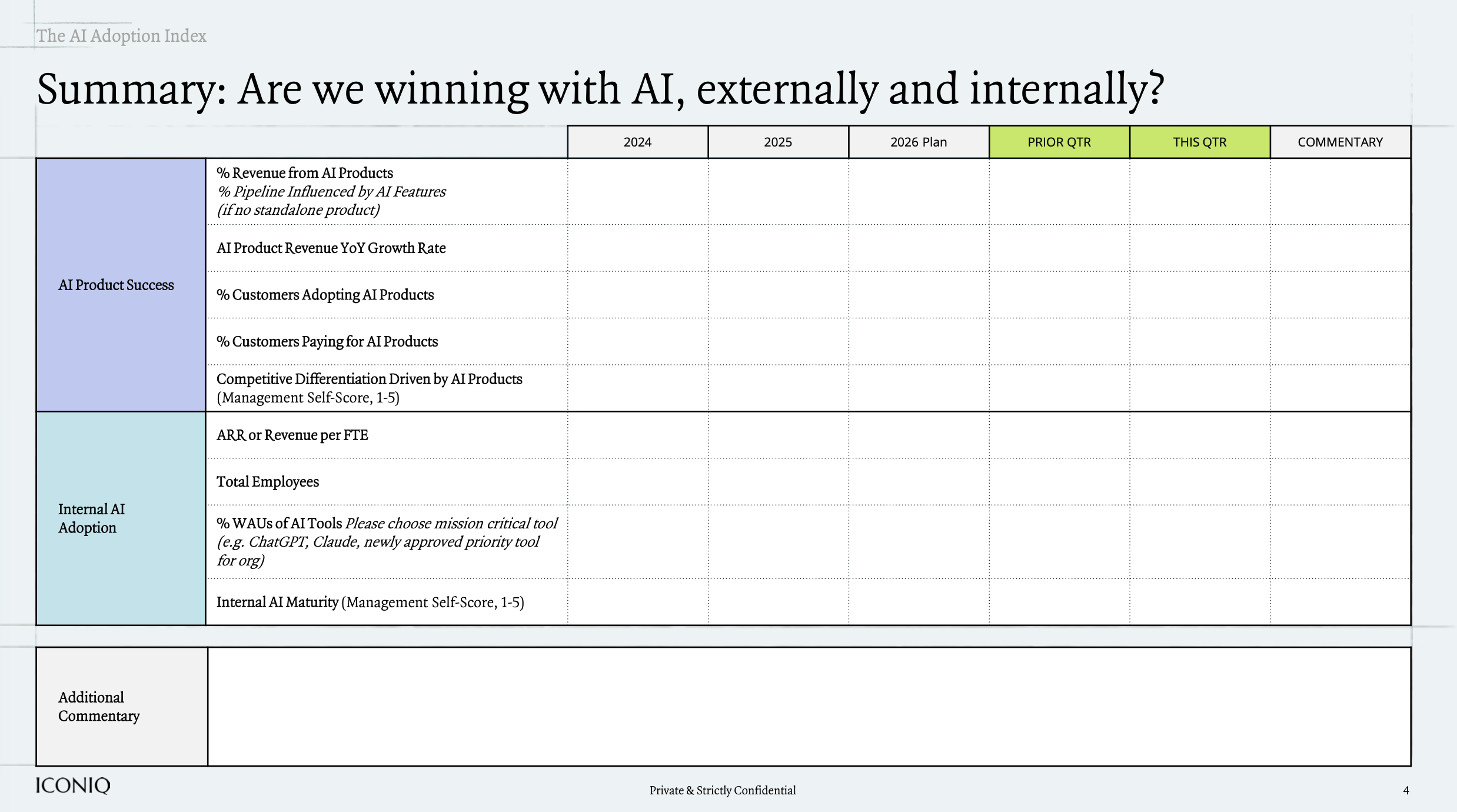
The template has two layers. A summary view keeps the board conversation focused (are we succeeding with AI, externally and internally?) without getting lost in the weeds. A set of functional pages for R&D, sales, marketing, customer success, and G&A goes deeper into the tactical inputs and leading indicators that functional leaders can actually influence, connecting day-to-day execution to the outcomes that matter at the board level.
The intent isn't to be comprehensive. What matters most will vary by business. Our recommendation is to update it quarterly, focus on trends rather than perfection, and pick a small set of metrics that best represent AI's intended impact on your company. Early quarters may be directional or estimated. Consistency and longitudinal improvement over time matters more than precision from day one.
What the data is telling us
At ICONIQ, we've been tracking AI adoption across our portfolio through CFO surveys, board decks, and direct company reporting.
Across the 38 portfolio companies we surveyed, 97-99% of employees have access to AI tools. Access is table stakes.
What separates leaders appears to be depth. In R&D, 86% of employees use AI daily and nearly half are power users (defined as 50%+ productivity gains). In GTM and G&A, daily usage sits around 70-74%, but power-user rates drop to 30%. The gap between access and meaningful productivity gain is where most companies are stuck.
R&D: the clearest ROI, and real structural implications
Engineering has moved the furthest and fastest among the functions surveyed. Developer velocity, review cycle time, and features shipped are up roughly 40% across the portfolio. QA and testing teams are seeing similar gains (around 40% time savings) with test coverage rising as a byproduct.
AI-generated code ranges from 25% to 88% of committed code at individual companies, with most clustering between 50-75%.
Tooling has also consolidated. Claude and Claude Code is the most widely deployed across coding, QA, code review, DevOps, and product design, used by 82% of surveyed companies for coding assistance. Cursor is a consistent second.
Productivity gains are also translating into structural changes. Several companies have reduced R&D headcount by 15-25% as a direct result of AI efficiency gains. Others have frozen net new hiring while maintaining or accelerating output.
The companies seeing the sharpest gains tend to have three things in common: a standardized toolset, a cultural expectation of daily use, and accountability for results. One CTO managed out engineers perceived as AI laggards. Another company pairs any engineer not hitting a 2x productivity gain with an internal mentor.
GTM: output up, headcount flat
Content generation shows the highest relative productivity gain of any GTM use case (about 55% on average) which helps explain why marketing teams have been early and enthusiastic adopters. Sales outbound and pipeline generation are up about 45% in productivity improvement. GTM enrichment and orchestration are in the same range. Sales coaching and forecasting trail at 20–25%. In sales, the impact shows up in pipeline activity. One company saw a 200% increase in deal meetings per AE per month. Others are reporting shorter sales cycles, higher ACV, and better win rates tied to AI-powered prospect research and outreach personalization.
In customer success, AI-driven ticket resolution is the clearest benchmark that we have identified. The average AI ticket resolution rate across companies tracking it is around 50%, and one company has reached 65% AI resolution with an 86% CSAT score. Several companies have grown their CS portfolio 60%+ without adding headcount, and at least one has deferred all new CSM hiring for 2+ years.
In marketing, the gains show up in throughput and cost. One company operates with half its prior marketing headcount and ships 20% faster. Another ran 43% more events with the same team.
G&A: the underrated opportunity
G&A functions tend to get less attention in AI conversations, but the data shows real productivity impact. Customer service leads at ~55% in average time and cost savings. Legal and contract review shows ~45% savings. HR and recruiting shows a 75% reduction in candidate screening time and a 50% reduction in time-to-fill. FP&A automation is earlier in maturity, with ~25% savings, but the operational shift from multi-week close cycles to same-day reporting is already happening at several companies.
The agentic AI angle is especially relevant in G&A. One company built an autonomous QBR deck pipeline that pulls customer metrics from multiple systems and outputs branded slides with no human steps. Several others have deployed AI-powered legal assistants handling routine contract review and legal inquiries. A healthcare company is using AI agents for clinical intake, claims review, and member navigation, with the expectation that AI will materially reduce frontline staffing requirements.
Several companies have formally adopted an "AI-first backfill strategy": when a role opens, the first question is whether AI can fill it. Others are increasing manager spans of control to 10+ direct reports, enabled by reduced administrative overhead.
What this all adds up to
The companies pulling ahead aren't necessarily the ones with the most AI tools or the highest seat counts. In our view, they are the ones that decided what success looks like, measured it, and held people accountable to it. The pattern across our portfolio appears consistent: access is nearly universal, but power-user depth separates leaders from the rest, and that gap is often a culture and accountability problem rather than a technology one.
The right question at your next board or team meeting isn't "are we using AI?". It's "where is it moving the business, and where has it stalled?"
Download our AI Adoption Index below.
Disclaimer
The views expressed in this presentation are those of ICONIQ Venture & Growth ("ICONIQ" or the "firm"), are the result of proprietary research, may be subjective, and may not be relied upon in making an investment decision.
This presentation is for general information purposes only and does not constitute investment advice. This presentation must not be relied upon in connection with any investment decision. The information in this presentation is not intended to and does not constitute financial, accounting, tax, legal, investment, consulting or other professional advice or services. Nothing in this presentation is or should be construed as an offer, invitation or solicitation to engage in any investment activity or transaction, including an offer to sell or a solicitation of an offer to buy any securities which should only be made pursuant to definitive offering documents and subscription agreements, including without limitation, any investment fund or investment product referenced herein.
Any reproduction or distribution of this presentation in whole or in part, or the disclosure of any of its contents, without the prior consent of ICONIQ, is strictly unauthorized.
This presentation may contain forward-looking statements based on current plans, estimates and projections. The recipient of this presentation ("you") are cautioned that a number of important factors could cause actual results or outcomes to differ materially from those expressed in, or implied by, the forward-looking statements. The numbers, figures and case studies included in this presentation have been included for purposes of illustration only, and no assurance can be given that the actual results of ICONIQ or any of its partners and affiliates will correspond with the results contemplated in the presentation. No information is contained herein with respect to conflicts of interest, which may be significant. The portfolio companies and other parties mentioned herein may reflect a selective list of the prior investments made by ICONIQ.
Certain of the economic and market information contained herein may have been obtained from published sources and/or prepared by other parties. While such sources are believed to be reliable, none of ICONIQ or any of its affiliates and partners, employees and representatives assume any responsibility for the accuracy of such information.
All of the information in the presentation is presented as of the date made available to you (except as otherwise specified), and is subject to change without notice, and may not be current or may have changed (possibly materially) between the date made available to you and the date actually received or reviewed by you. ICONIQ assumes no obligation to update or otherwise revise any information, projections, forecasts or estimates contained in the presentation, including any revisions to reflect changes in economic or market conditions or other circumstances arising after the date the items were made available to you or to reflect the occurrence of unanticipated events.
For avoidance of doubt, ICONIQ is not acting as an adviser or fiduciary in any respect in connection with providing this presentation and no relationship shall arise between you and ICONIQ as a result of this presentation being made available to you.
ICONIQ is a diversified financial services firm and has direct client relationships with persons that may become limited partners of ICONIQ funds. Notwithstanding that a person may be referred to herein as a "client" of the firm, no limited partner of any fund will, in its capacity as such, be a client of ICONIQ. There can be no assurance that the investments made by any ICONIQ fund will be profitable or will equal the performance of prior investments made by persons described in this presentation.
Any information in this presentation is directed at, and intended for, only persons who are experienced institutional or professional investors (“professional investors”) as defined by applicable law and regulation. Any person that is not a professional investor is not an intended recipient of this presentation and the matters discussed herein.
ICONIQ is a trading name of certain ICONIQ Partners (UK) LLP. ICONIQ Partners (UK) LLP (Registration Number: 973080) is an appointed representative of Kroll Securities Ltd. (Registration Number: 466588) which is authorised and regulated by the Financial Conduct Authority. ICONIQ Partners (UK) LLP is a limited liability partnership whose members are ICONIQ Capital (UK) Ltd, Seth Pierrepont and Lou Thorne, and it is registered in England and Wales and has its registered office at 27 Soho Square, London W1D 3QR. ICONIQ Partners (UK) LLP acts as an adviser to ICONIQ Capital LLC
Unless otherwise indicated, the views expressed in this presentation are those of ICONIQ Venture and Growth (“ICONIQ" or the “Firm"), are the result of proprietary research, may be subjective, and may not be relied upon in making an investment decision. Information used in this presentation was obtained from numerous sources. Certain of these companies are portfolio companies of ICONIQ Venture and Growth. ICONIQ Venture and Growth does not make any representations or warranties as to the accuracy of the information obtained from these sources.
This presentation is for general information purposes only and does not constitute investment advice. This presentation must not be relied upon in connection with any investment decision. The information in this presentation is not intended to and does not constitute financial, accounting, tax, legal, investment, consulting or other professional advice or services. Nothing in this presentation is or should be construed as an offer, invitation or solicitation to engage in any investment activity or transaction, including an offer to sell or a solicitation of an offer to buy any securities which should only be made pursuant to definitive offering documents and subscription agreements, including without limitation, any investment fund or investment product referenced herein.
Any reproduction or distribution of this presentation in whole or in part, or the disclosure of any of its contents, without the prior consent of ICONIQ, is strictly unauthorized.
This presentation may contain forward-looking statements based on current plans, estimates and projections. The recipient of this presentation ("you") are cautioned that a number of important factors could cause actual results or outcomes to differ materially from those expressed in, or implied by, the forward-looking statements. The numbers, figures and case studies included in this presentation have been included for purposes of illustration only, and no assurance can be given that the actual results of ICONIQ or any of its partners and affiliates will correspond with the results contemplated in the presentation. No information is contained herein with respect to conflicts of interest, which may be significant. The portfolio companies and other parties mentioned herein may reflect a selective list of the prior investments made by ICONIQ.
Certain of the economic and market information contained herein may have been obtained from published sources and/or prepared by other parties. While such sources are believed to be reliable, none of ICONIQ or any of its affiliates and partners, employees and representatives assume any responsibility for the accuracy of such information.
All of the information in the presentation is presented as of the date made available to you (except as otherwise specified), and is subject to change without notice, and may not be current or may have changed (possibly materially) between the date made available to you and the date actually received or reviewed by you. ICONIQ assumes no obligation to update or otherwise revise any information, projections, forecasts or estimates contained in the presentation, including any revisions to reflect changes in economic or market conditions or other circumstances arising after the date the items were made available to you or to reflect the occurrence of unanticipated events. Numbers or amounts herein may increase or decrease as a result of currency fluctuations.
For avoidance of doubt, ICONIQ is not acting as an adviser or fiduciary in any respect in connection with providing this presentation and no relationship shall arise between you and ICONIQ as a result of this presentation being made available to you.
ICONIQ is a diversified financial services firm and has direct client relationships with persons that may become limited partners of ICONIQ funds. Notwithstanding that a person may be referred to herein as a "client" of the firm, no limited partner of any fund will, in its capacity as such, be a client of ICONIQ. There can be no assurance that the investments made by any ICONIQ fund will be profitable or will equal the performance of prior investments made by persons described in this presentation.
Any information in this presentation is directed at, and intended for, only persons who are experienced institutional or professional investors (“professional investors”) as defined by applicable law and regulation. Any person that is not a professional investor is not an intended recipient of this presentation and the matters discussed herein.
ICONIQ is a trading name of ICONIQ Partners (UK) LLP. ICONIQ Partners (UK) LLP (Registration Number: 973080) is an appointed representative of Kroll Securities Ltd. (Registration Number: 466588) which is authorised and regulated by the Financial Conduct Authority. ICONIQ Partners (UK) LLP is a limited liability partnership whose members are ICONIQ Capital (UK) Ltd, Seth Pierrepont and Lou Thorne, and it is registered in England and Wales and has its registered office at 27 Soho Square, London W1D 3QR. ICONIQ Partners (UK) LLP acts as an adviser to ICONIQ Capital LLC