
.jpg)
The FDE Advantage: Turning Deployment into Compounding Value
How companies use forward deployed engineers (FDEs), how they price and structure them, and whether the model is here to stay.

AI is moving faster than buyers can adopt it, and vendors are racing to build some kind of forward deployed function, betting the role wins and keeps enterprise accounts. Customers are sold on transformation before they know how the tool fits into how their teams actually work, and that's the gap FDEs are hired to close.
Definitions vary, but at a minimum, an FDE is a technical resource embedded directly inside a customer's environment: scoping the deal, building integrations or net-new capabilities, and staying through deployment until the product produces real outcomes. The model traces back to Palantir, and over the past 18 months it has spread widely across AI-native companies, legacy enterprise vendors, and hyperscalers.
Our 2026 State of AI Report shows how quickly the function is growing: 37% of AI builder respondents already employ FDEs, 22% are hiring them, and 50% plan to make the role a permanent part of their go-to-market motion.
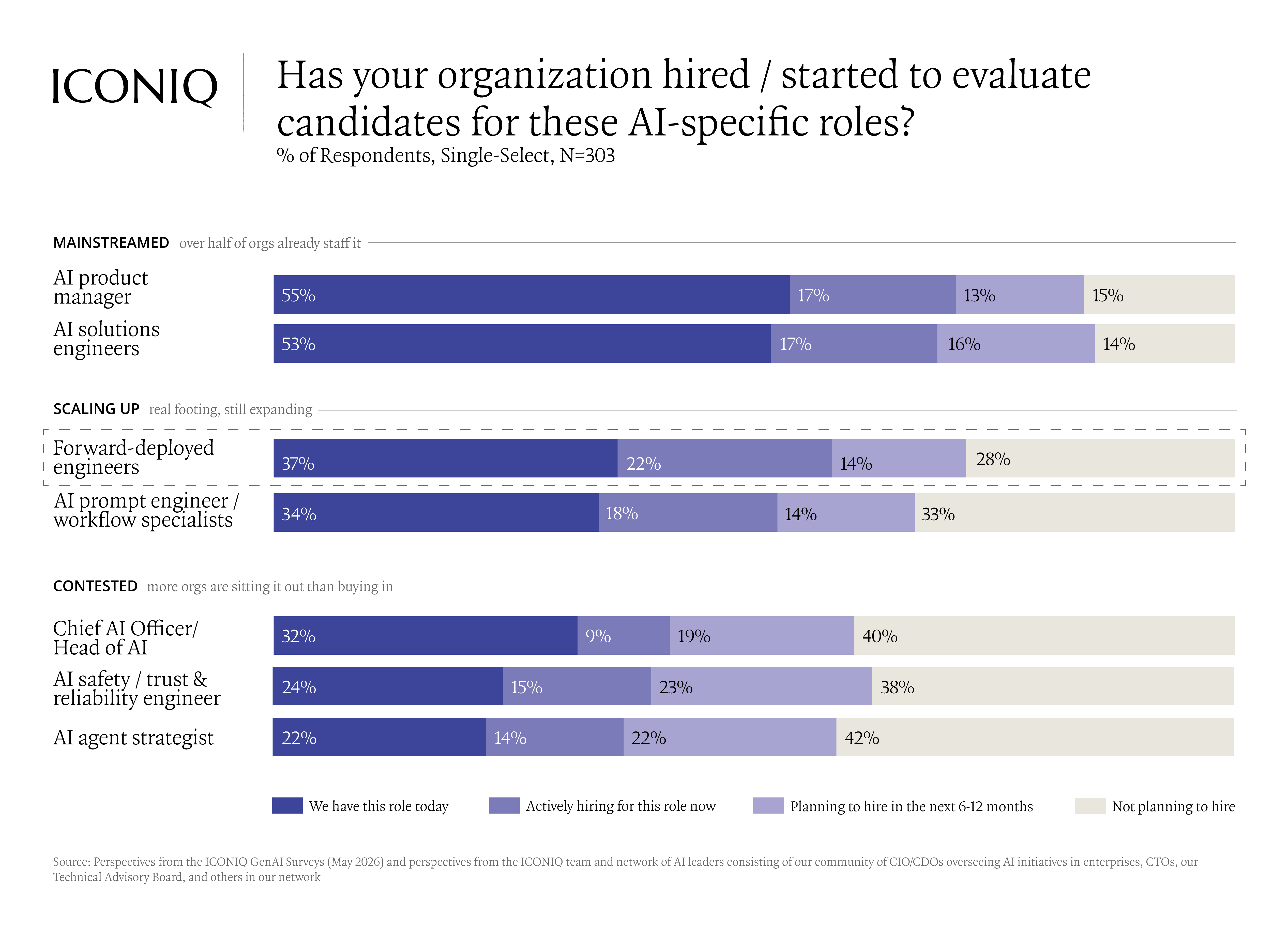
Yet for a role scaling this quickly, there is remarkably little consensus on what it actually means to execute this model.
Drawing from our proprietary surveys, portfolio learnings, and conversations with operators, we believe the FDE role is a permanent restructuring of the GTM motion, built to compound enterprise value even as the work inside changes over time.
Is FDE a bridge, or a permanent restructuring of GTM?
The surge in FDEs sends competing signals: a permanent restructuring of enterprise GTM, or a temporary bridge while AI matures enough to solve enterprise problems without customized support.
Our take: FDEs signal a permanent restructuring of enterprise GTM, driving revenue, adoption, and product feedback loops.
As frontier model quality converges, companies increasingly have access to the same underlying capabilities, shifting competitive differentiation toward how deeply a vendor embeds inside customer workflows to solve complex problems and drive measurable outcomes. FDEs can be a primary lever for building that differentiation, particularly when deployments demand a total overhaul of customer workflows rather than a point solution.
Generally, in those cases, FDEs become the linchpins for delivering results. Some argue the role is temporary: as AI writes more of the code, the need for FDEs will fade. But one of the hardest parts of an enterprise AI deployment is defining the problem and earning customer trust, not writing the code. FDEs work through that ambiguity, define the problem directly working with customers, and design deployments that can succeed over time.
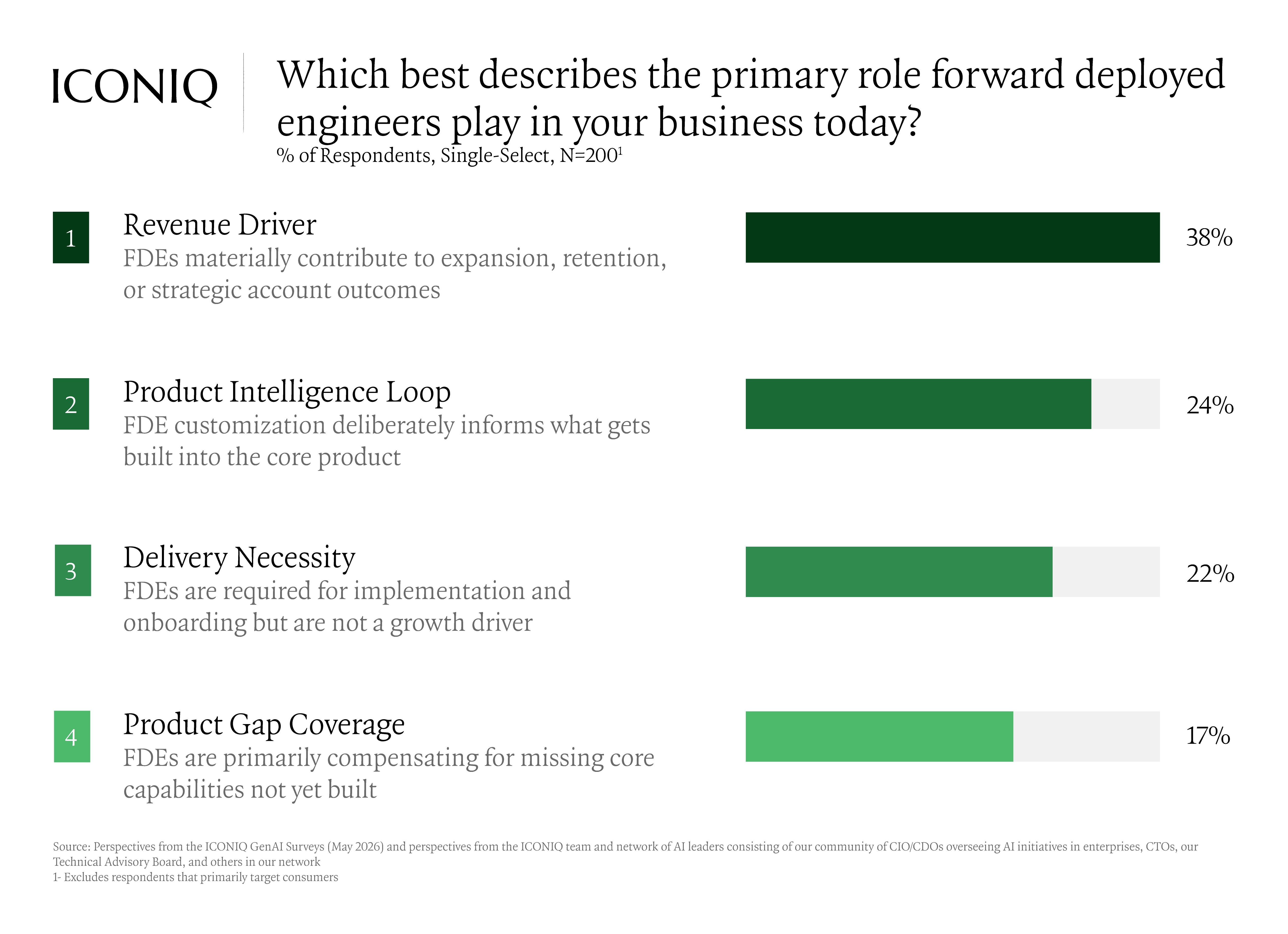
Companies are scaling the model because it pays for itself twice. 38% run FDEs as a revenue engine, materially contributing to expansion, retention, and strategic account outcomes. 24% run them as a product intelligence engine, where field customization feeds directly back into the core roadmap. Some of the most effective companies do both, generating near-term revenue while converting field insight into long-term product leverage. That dual return is what makes the model lasting.
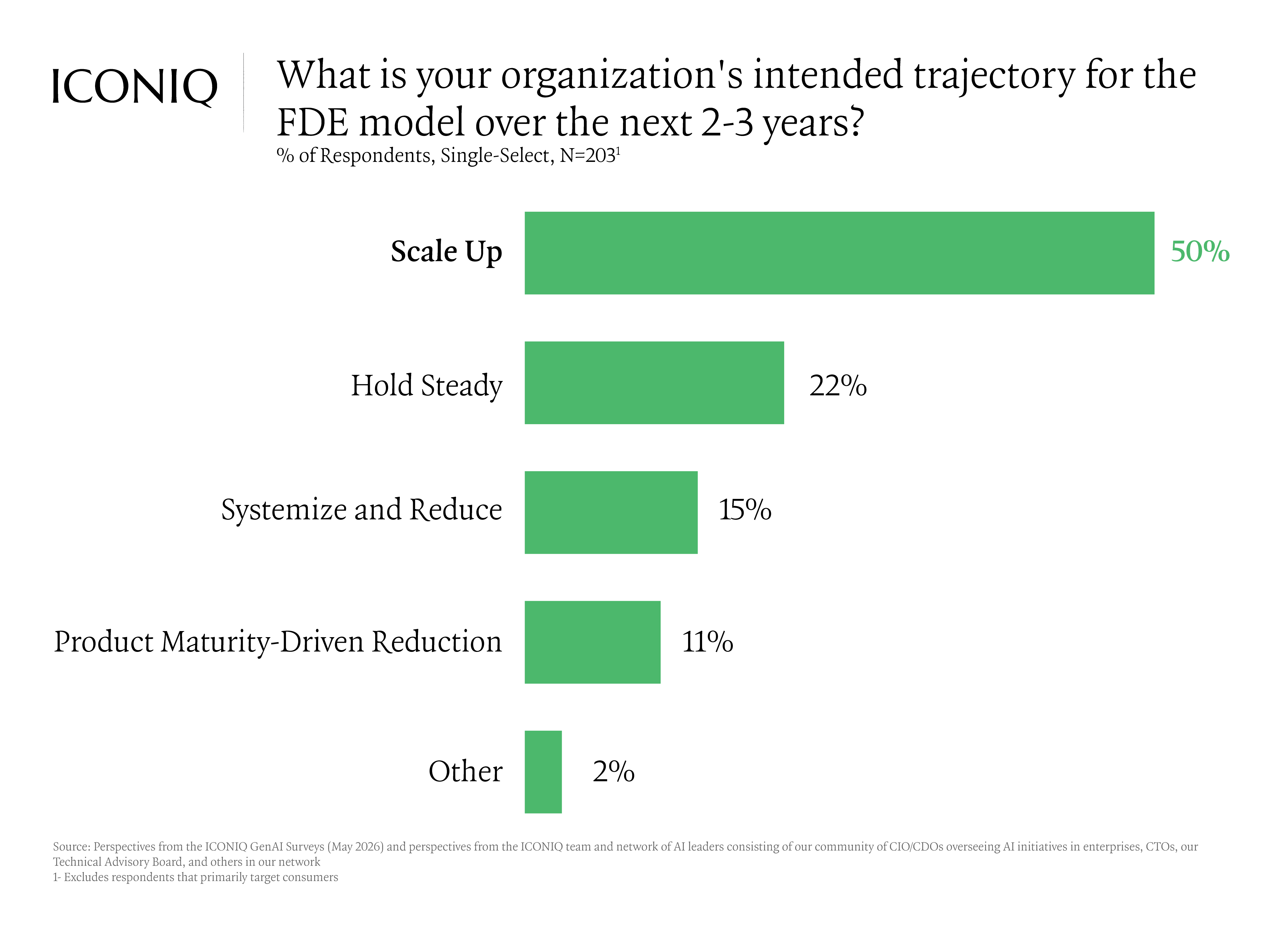
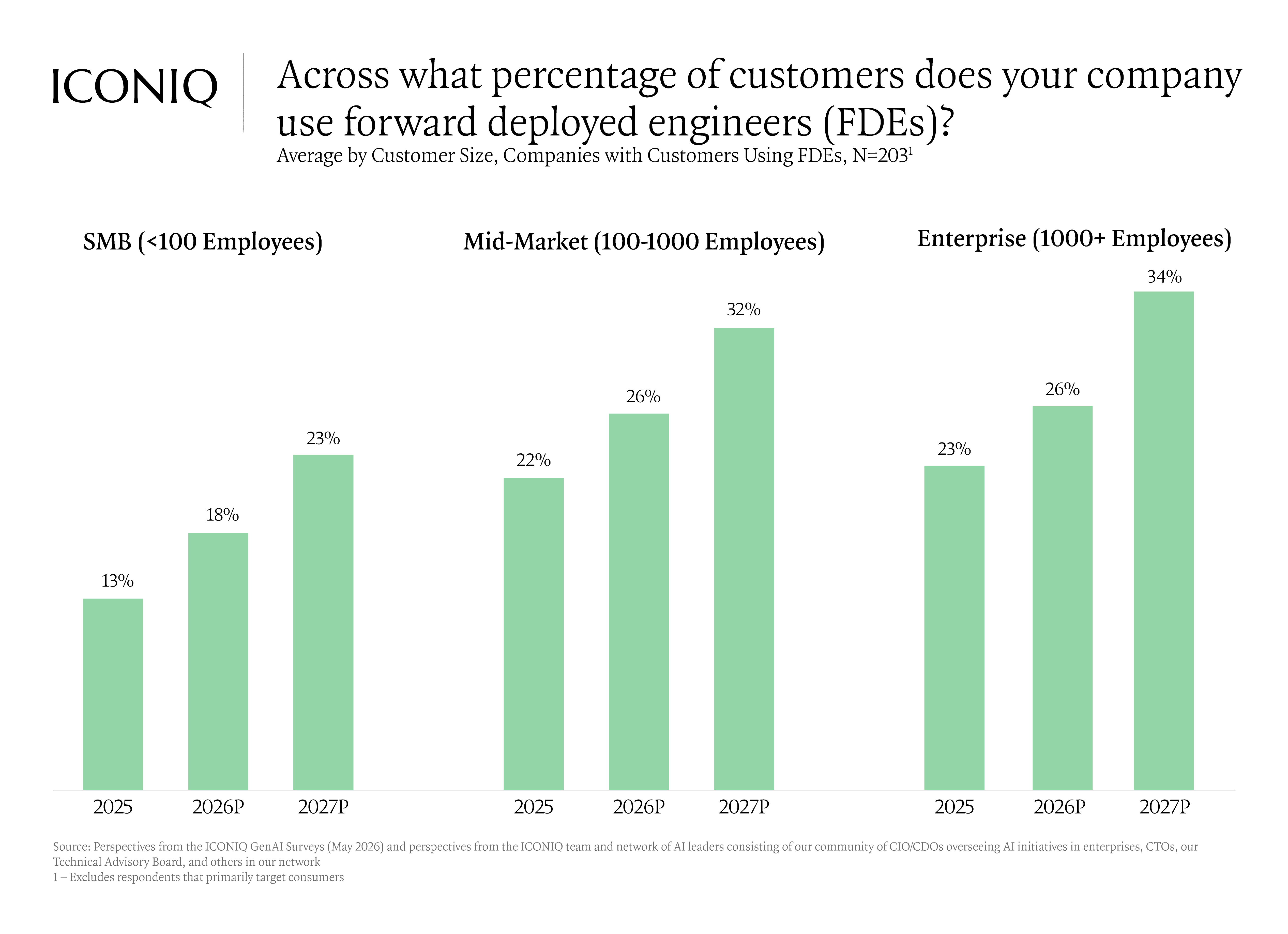
Our 2026 State of AI Report shows half of the surveyed companies plan to scale their FDE model as a permanent part of their GTM motion, and AI builder respondents expect integration to reach 34% of enterprise customers by 2027. The trajectory points to a larger but still selective role, concentrated in complex, high-value deployments rather than broad account coverage.

.png)
That commitment is also visible in the broader market, and the labs and hyperscalers are also placing their bets. Microsoft committed $2.5B and 6,000 employees to Microsoft Frontier Company, embedding FDEs and industry-specialist sellers directly inside enterprise customers, and AWS put $1B behind its own unit days earlier. The AI labs moved faster and further. OpenAI raised over $4B for its Deployment Company in May, and Anthropic took a different approach by launching Ode with Anthropic, a standalone company backed by a consortium of leading investors. These investments reinforce that embedded deployment is becoming a lasting part of enterprise AI, even as the right operating model remains unsettled.
The scale of these commitments makes the execution question more urgent to avoid technical debt. On extensible platforms, customer-facing engineers build reusable product improvements that strengthen the core roadmap. On traditional architectures, the role drifts into a high-maintenance services function, layering bespoke work on top of the product; that work becomes increasingly expensive and reduces the amount of reusable code that can flow back into the core roadmap.
The footprint must also evolve as the product matures, with FDEs focused on customer profiles with repeatable needs. ElevenLabs, for example, deliberately pulls FDEs back once a problem class can be solved out of the box, on the logic that today’s FDE work should eventually dissolve back into product as tooling matures.
As FDE adoption expands, we expect the companies that outperform will be those that scale customer impact without allowing bespoke work to accumulate. That outcome depends on disciplined choices about where FDEs are deployed and how the function is structured, staffed, and measured.
How AI companies structure, staff, and measure FDE teams
No consensus operating model has emerged, largely because what an FDE does depends heavily on the company, product, and customer. In a fast-moving market, the best models stay agile and customer-first, guided by five principles.
- Reporting lines: decide by competency, not title. The emerging rule is that people making actual code changes sit in R&D, while scoping, configuration, and change management often live in GTM. Ramp houses FDEs in engineering because most of the work now feeds the core roadmap. Anthropic places the function in GTM because the job is as much about helping customers get the most from their use of Claude as it is writing code.
- Timing: FDE orgs are built on mature products. Operators describe a clear sequence: documentation handles early questions, solution engineering comes next, and FDEs become essential only once a company sells outcomes that require enterprise transformation. For a ten-engineer startup with a handful of enterprise deals, operators say everyone should be an “FDE.” The moment to formalize the role is when customer requests become a distraction for some engineers and traction for others.
- Team composition: the role is specializing into sub-functions. At scale, the team splits into customer-facing generalists, builders, and technical implementers. ElevenLabs, which grew its FDE function from 12 to 60+ people in under a year, runs three roles: forward deployed software engineers, deployment strategists, and solution engineers. Anthropic built an Applied AI team, which includes customer-facing AI researchers, engineers, and product experts who move across accounts shaping agent architectures while dedicated FDEs go deep on one customer. Some companies, including Anthropic, fully embed with customers rather than optimize for short-term bookings, which preserves trust and technical depth in engagements.
- Embracing AI: what we view as leading teams are building “FDE factories.” To optimize workflows, FDEs use agentic pipelines to turn inbound requests into a first-pass response, spec, and agent handoff. From there, the role splits in two: one path toward AI engineering and orchestration, the other toward customer judgment, problem definition, and change management.
- Measuring success: ROI follows the org. Revenue retention remains the north star, alongside win rates on FDE-supported deals and downstream product impact such as features that originated from customer deployments. Teams that place FDEs in the GTM org tend to treat them as part of the cost of sale and evaluate margin, deal cycle time, and overall sales efficiency.
Beyond these five principles, attribution and capacity remain unresolved. Companies often cannot isolate how much of a deal was driven by FDE work, even though each additional deployment often requires more headcount. Without that visibility, teams risk either constraining growth through underinvestment or diluting margins through overstaffing. This attribution challenge also shapes how companies monetize the function.
How AI companies price and charge for FDEs
Monetization of the FDE model is fragmented. 30% of companies bundle FDEs into the software subscription cost, 29% charge a separate professional services fee, and 25% run a hybrid. That fragmentation is a reflection of the attribution challenge: without a clear way to price the value FDEs create, companies default to charging for access, time, or capacity rather than outcomes.
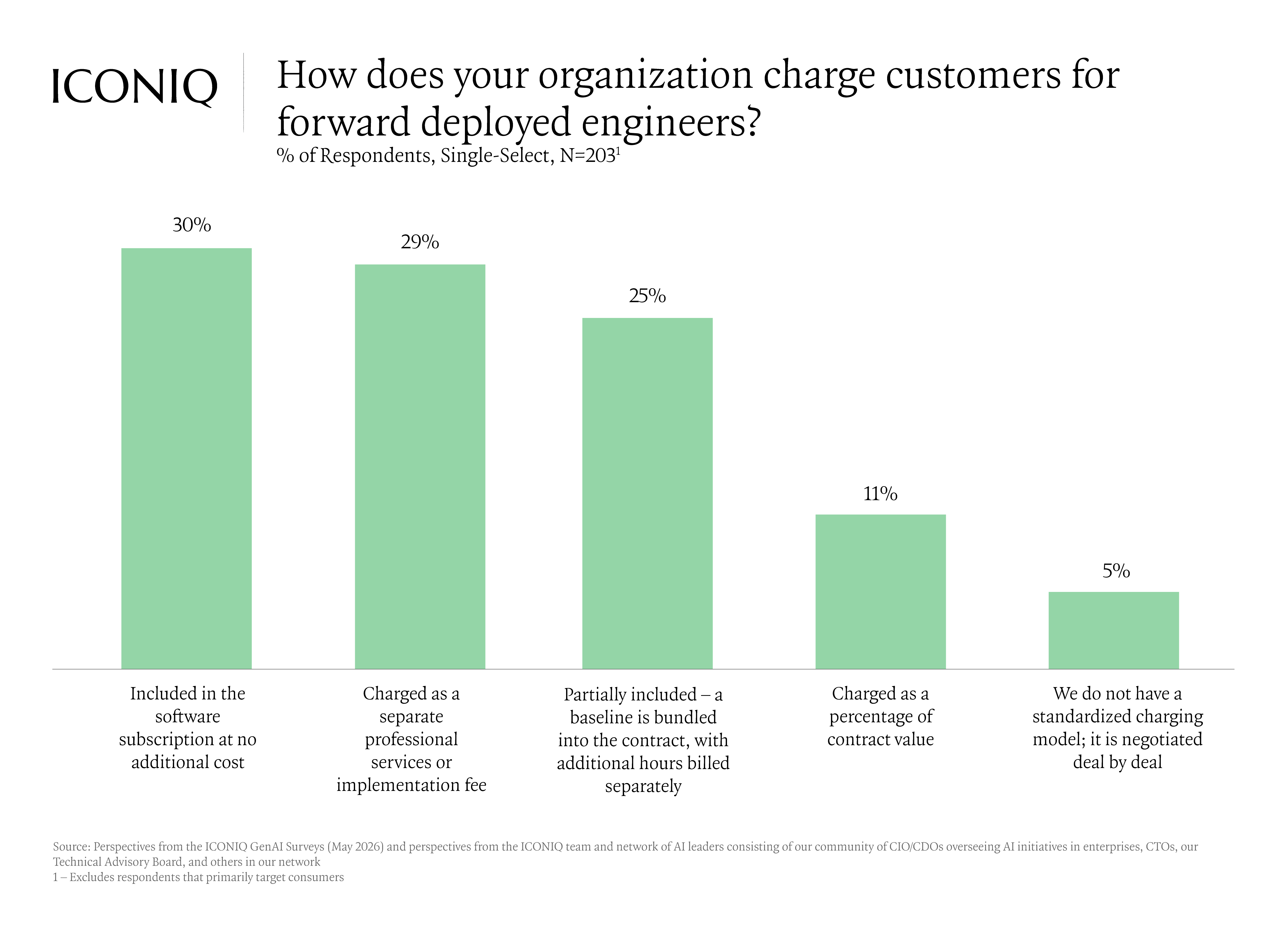
Operator anecdotes show just how wide the market runs:
- An early-stage AI native charges a $40-45K total annual contract with one week of FDE support bundled in.
- A legacy public enterprise AI company charges $500K for a six-month land pilot and only pursues use cases where it can demonstrate 10x financial impact.
- A public infrastructure company bills hourly for FDEs, up to $10K per day.
While FDEs are largely monetized based on effort today, we do not expect that model to last. As vendors become better able to verify financial impact, pricing could shift toward the value delivered. We believe the first companies to make the pricing shift will reset the market. The $500K pilot with a 10x impact example offers an early version of where pricing may go.
How AI companies hire and pay FDEs
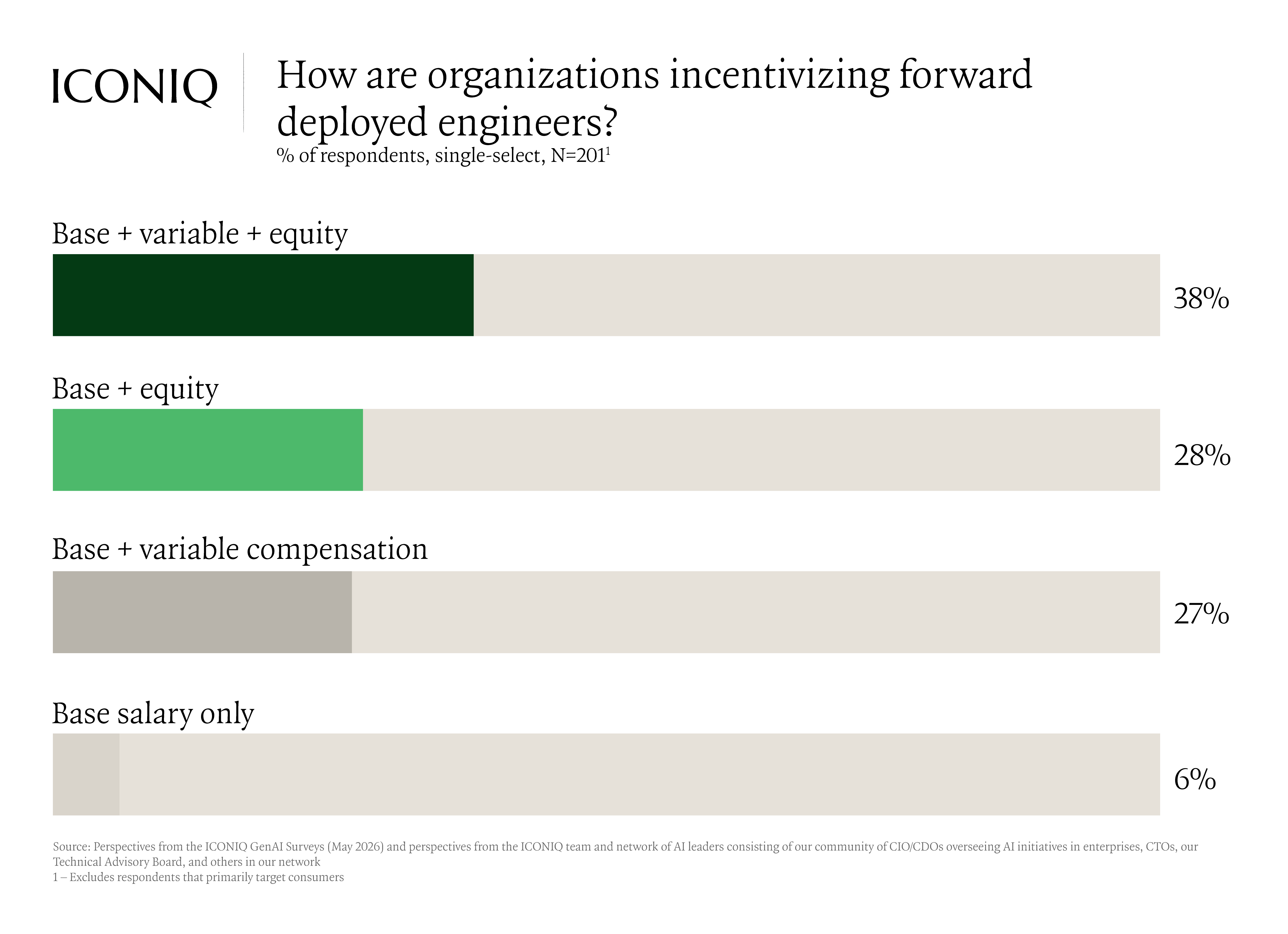
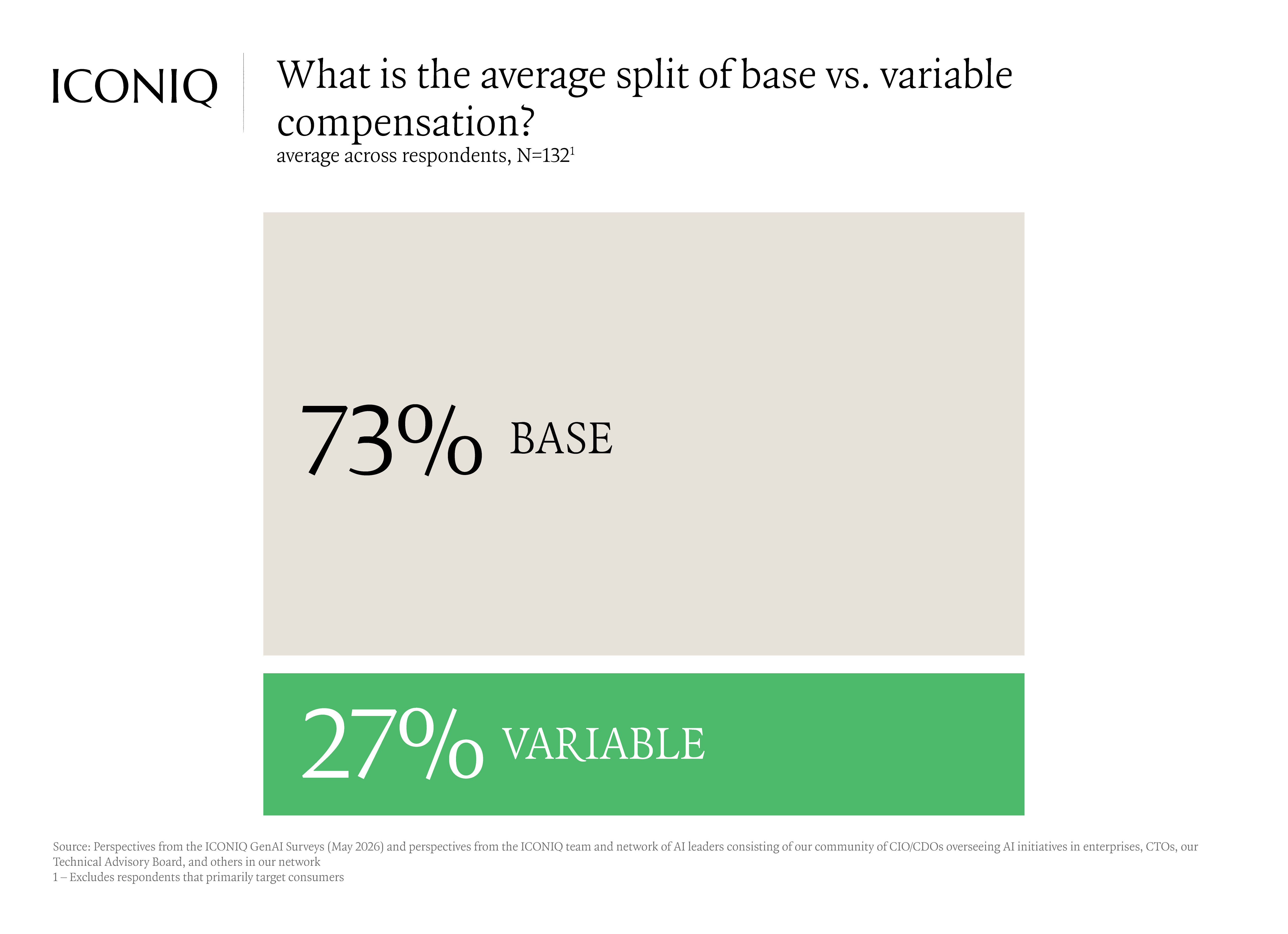
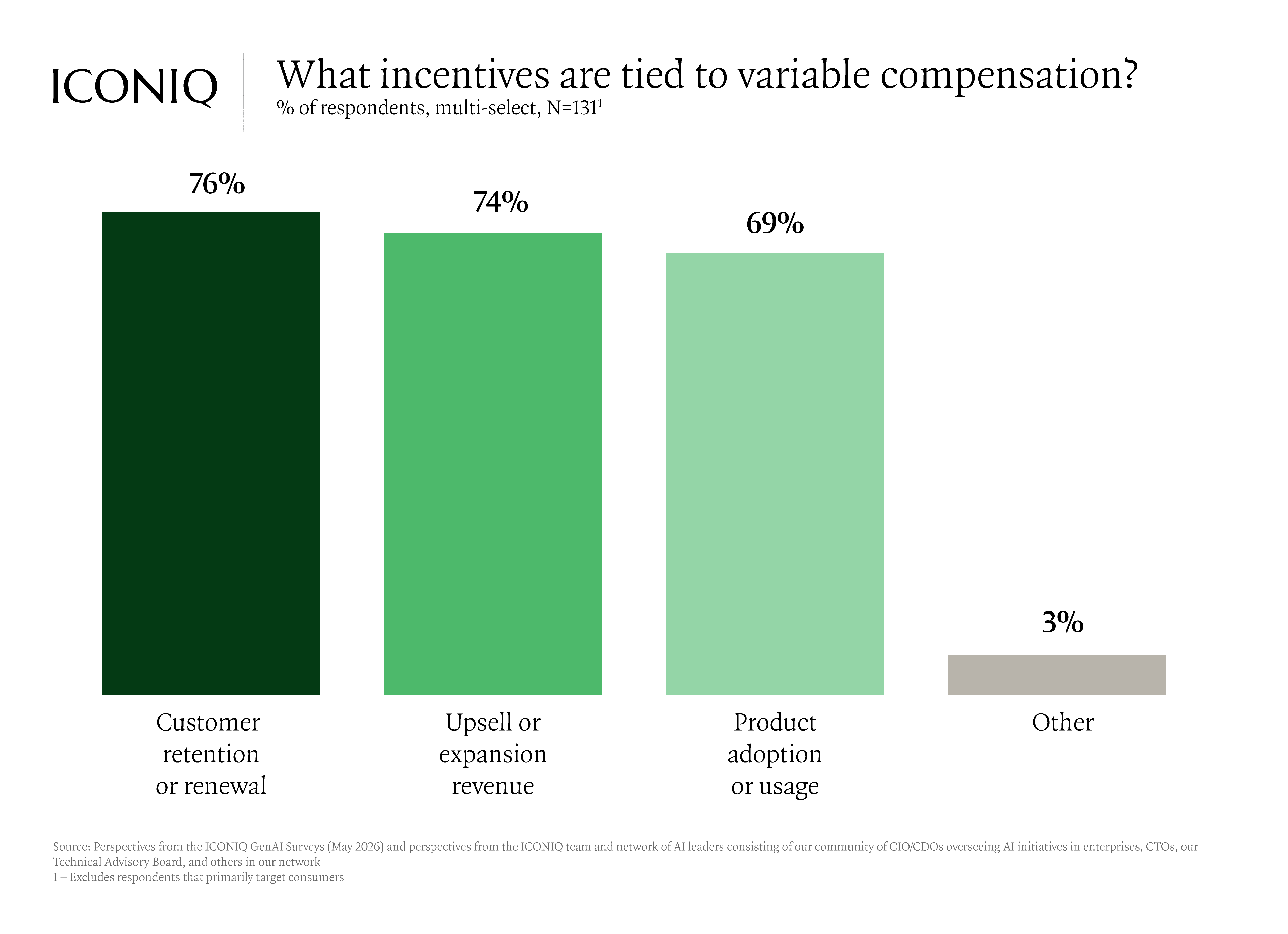
Regardless of how the motion is priced, its economics depend on the people delivering it. Candidates who combine strong engineering skills with sound customer judgment are scarce, and incentive design should reflect that hybrid profile. Most companies surveyed in our 2026 State of AI report compensate with variable pay: 65% of FDEs receive some form of it, with an average 73/27 base-to-variable split, most often tied to customer retention and renewal.
The profile: engineers first, screened for judgement
ElevenLabs describes the role as an engineer who wants to talk to customers. Ramp holds FDE candidates to the same technical bar as core engineers, then adds behavioral interviews that screen for communication and the motivation to help others. Anthropic still requires a software development interview but screens hardest on organizational judgment.
Career progression: the unsolved part of the model
Career pathing is the question operators ask each other and admit they haven't answered. Ramp, with FDEs inside engineering, runs them on the same leveling guide as core engineering. Some companies position the role as a tour of duty that develops founder-like skills. A few operators are even starting to advertise it explicitly as a launchpad, on the logic that the technical and customer-facing mix produces the kind of person who eventually starts their own company.
Final Thoughts
The rise of FDEs reflects a broader shift in enterprise software: more value is being created after the sale, through implementation, adoption, and workflow redesign. Some of the strongest models we have seen distinguish reusable product work from one-off services, build toward customer self-sufficiency, and make deliberate choices about pricing, measurement, and career paths.
But the market is placing a multi-billion-dollar bet on a role it still can't cleanly attribute revenue to. Anthropic, AWS, Microsoft, and OpenAI are all funding embedded deployment at scale before anyone has answered the question on how much of the deal did the FDE actually drove.The companies that crack the attribution problem first will be the ones that know how much FDE they can afford.
Looking ahead, we believe the role will look different in a few years. Coding could stop being the bottleneck it is today, and the FDE function will split along the line that's already forming, one path toward orchestrating agents and designing context, the other toward the harder, less automatable work of reading an organization and navigating how decisions get made inside it. The title may fragment, but the underlying job, helping large organizations change how they work, is here to stay.
For the full State of AI in 2026, download the report here.
Disclaimer
The views expressed in this presentation are those of ICONIQ Venture & Growth ("ICONIQ" or the "firm"), are the result of proprietary research, may be subjective, and may not be relied upon in making an investment decision.
This presentation is for general information purposes only and does not constitute investment advice. This presentation must not be relied upon in connection with any investment decision. The information in this presentation is not intended to and does not constitute financial, accounting, tax, legal, investment, consulting or other professional advice or services. Nothing in this presentation is or should be construed as an offer, invitation or solicitation to engage in any investment activity or transaction, including an offer to sell or a solicitation of an offer to buy any securities which should only be made pursuant to definitive offering documents and subscription agreements, including without limitation, any investment fund or investment product referenced herein.
Any reproduction or distribution of this presentation in whole or in part, or the disclosure of any of its contents, without the prior consent of ICONIQ, is strictly unauthorized.
This presentation may contain forward-looking statements based on current plans, estimates and projections. The recipient of this presentation ("you") are cautioned that a number of important factors could cause actual results or outcomes to differ materially from those expressed in, or implied by, the forward-looking statements. The numbers, figures and case studies included in this presentation have been included for purposes of illustration only, and no assurance can be given that the actual results of ICONIQ or any of its partners and affiliates will correspond with the results contemplated in the presentation. No information is contained herein with respect to conflicts of interest, which may be significant. The portfolio companies and other parties mentioned herein may reflect a selective list of the prior investments made by ICONIQ.
Certain of the economic and market information contained herein may have been obtained from published sources and/or prepared by other parties. While such sources are believed to be reliable, none of ICONIQ or any of its affiliates and partners, employees and representatives assume any responsibility for the accuracy of such information.
All of the information in the presentation is presented as of the date made available to you (except as otherwise specified), and is subject to change without notice, and may not be current or may have changed (possibly materially) between the date made available to you and the date actually received or reviewed by you. ICONIQ assumes no obligation to update or otherwise revise any information, projections, forecasts or estimates contained in the presentation, including any revisions to reflect changes in economic or market conditions or other circumstances arising after the date the items were made available to you or to reflect the occurrence of unanticipated events.
For avoidance of doubt, ICONIQ is not acting as an adviser or fiduciary in any respect in connection with providing this presentation and no relationship shall arise between you and ICONIQ as a result of this presentation being made available to you.
ICONIQ is a diversified financial services firm and has direct client relationships with persons that may become limited partners of ICONIQ funds. Notwithstanding that a person may be referred to herein as a "client" of the firm, no limited partner of any fund will, in its capacity as such, be a client of ICONIQ. There can be no assurance that the investments made by any ICONIQ fund will be profitable or will equal the performance of prior investments made by persons described in this presentation.
Any information in this presentation is directed at, and intended for, only persons who are experienced institutional or professional investors (“professional investors”) as defined by applicable law and regulation. Any person that is not a professional investor is not an intended recipient of this presentation and the matters discussed herein.
ICONIQ is a trading name of certain ICONIQ Partners (UK) LLP. ICONIQ Partners (UK) LLP (Registration Number: 973080) is an appointed representative of Kroll Securities Ltd. (Registration Number: 466588) which is authorised and regulated by the Financial Conduct Authority. ICONIQ Partners (UK) LLP is a limited liability partnership whose members are ICONIQ Capital (UK) Ltd, Seth Pierrepont and Lou Thorne, and it is registered in England and Wales and has its registered office at 27 Soho Square, London W1D 3QR. ICONIQ Partners (UK) LLP acts as an adviser to ICONIQ Capital LLC
Unless otherwise indicated, the views expressed in this presentation are those of ICONIQ Venture and Growth (“ICONIQ" or the “Firm"), are the result of proprietary research, may be subjective, and may not be relied upon in making an investment decision. Information used in this presentation was obtained from numerous sources. Certain of these companies are portfolio companies of ICONIQ Venture and Growth. ICONIQ Venture and Growth does not make any representations or warranties as to the accuracy of the information obtained from these sources.
This presentation is for general information purposes only and does not constitute investment advice. This presentation must not be relied upon in connection with any investment decision. The information in this presentation is not intended to and does not constitute financial, accounting, tax, legal, investment, consulting or other professional advice or services. Nothing in this presentation is or should be construed as an offer, invitation or solicitation to engage in any investment activity or transaction, including an offer to sell or a solicitation of an offer to buy any securities which should only be made pursuant to definitive offering documents and subscription agreements, including without limitation, any investment fund or investment product referenced herein.
Any reproduction or distribution of this presentation in whole or in part, or the disclosure of any of its contents, without the prior consent of ICONIQ, is strictly unauthorized.
This presentation may contain forward-looking statements based on current plans, estimates and projections. The recipient of this presentation ("you") are cautioned that a number of important factors could cause actual results or outcomes to differ materially from those expressed in, or implied by, the forward-looking statements. The numbers, figures and case studies included in this presentation have been included for purposes of illustration only, and no assurance can be given that the actual results of ICONIQ or any of its partners and affiliates will correspond with the results contemplated in the presentation. No information is contained herein with respect to conflicts of interest, which may be significant. The portfolio companies and other parties mentioned herein may reflect a selective list of the prior investments made by ICONIQ.
Certain of the economic and market information contained herein may have been obtained from published sources and/or prepared by other parties. While such sources are believed to be reliable, none of ICONIQ or any of its affiliates and partners, employees and representatives assume any responsibility for the accuracy of such information.
All of the information in the presentation is presented as of the date made available to you (except as otherwise specified), and is subject to change without notice, and may not be current or may have changed (possibly materially) between the date made available to you and the date actually received or reviewed by you. ICONIQ assumes no obligation to update or otherwise revise any information, projections, forecasts or estimates contained in the presentation, including any revisions to reflect changes in economic or market conditions or other circumstances arising after the date the items were made available to you or to reflect the occurrence of unanticipated events. Numbers or amounts herein may increase or decrease as a result of currency fluctuations.
For avoidance of doubt, ICONIQ is not acting as an adviser or fiduciary in any respect in connection with providing this presentation and no relationship shall arise between you and ICONIQ as a result of this presentation being made available to you.
ICONIQ is a diversified financial services firm and has direct client relationships with persons that may become limited partners of ICONIQ funds. Notwithstanding that a person may be referred to herein as a "client" of the firm, no limited partner of any fund will, in its capacity as such, be a client of ICONIQ. There can be no assurance that the investments made by any ICONIQ fund will be profitable or will equal the performance of prior investments made by persons described in this presentation.
Any information in this presentation is directed at, and intended for, only persons who are experienced institutional or professional investors (“professional investors”) as defined by applicable law and regulation. Any person that is not a professional investor is not an intended recipient of this presentation and the matters discussed herein.
ICONIQ is a trading name of ICONIQ Partners (UK) LLP. ICONIQ Partners (UK) LLP (Registration Number: 973080) is an appointed representative of Kroll Securities Ltd. (Registration Number: 466588) which is authorised and regulated by the Financial Conduct Authority. ICONIQ Partners (UK) LLP is a limited liability partnership whose members are ICONIQ Capital (UK) Ltd, Seth Pierrepont and Lou Thorne, and it is registered in England and Wales and has its registered office at 27 Soho Square, London W1D 3QR. ICONIQ Partners (UK) LLP acts as an adviser to ICONIQ Capital LLC