
If you're the CEO, CRO, or CFO of a tech company, you've probably had a pricing conversation this year, and there's a good chance it ended with a plan to tie what customers pay more closely to the value they receive.
For many companies, that plan includes a shift to consumption-based pricing. As compute costs scale with usage, pricing should generally reflect both the cost of delivering a product and the value customers receive. While outcome-based pricing is gaining traction, consumption remains a more common approach among the two, given it doesn’t come with some of the attribution challenges associated with pricing directly on outcomes.
But making the shift to consumption-based pricing is only the start. As revenue becomes more dependent on how customers use the product, the implications could extend well beyond pricing, reshaping how companies set quotas, compensate their teams, forecast revenue, and work across product, engineering, finance, and sales.
The first hurdle is often customer readiness, which varies considerably depending on who you are selling to. Infrastructure companies with consumption pricing, like Snowflake, tend to sell to technical buyers who already understand what metering means inside products. Application companies are often in a different position. Their buyers are accustomed to seats and subscriptions, so usage as spend can be an unfamiliar concept. That places more of a burden on the seller to introduce the model deliberately, invest in educating customers, and plan for a longer ramp, or you risk slowing adoption in a market that is still taking shape.
The other hurdle is internal. Your VP of Sales hedges when you ask what next quarter looks like. You get on a QBR and discover a customer's usage dropped because their own business slowed down, and now it's sitting in your forecast as a churn risk. Or a board member asks why NRR came in soft, and the answer is that an engineer shipped a performance improvement three weeks ago that quietly wiped out a nine-figure chunk of forecasted usage revenue before anyone in GTM knew it happened.
Both challenges come from the same shift. With consumption pricing, revenue depends on how much customers use the product. For customers, that means budgeting for a bill that changes from month to month. For the company, it means usage is measured in the product, which is an engineering call. But that same number now drives quotas, commissions, and the forecast, all of which used to sit entirely with revenue. In our view, there's no gap between those two teams anymore, so if they fall out of sync, the revenue team can be meaningfully impacted.
We sat down with operators from Anthropic, ElevenLabs, Glean, Legora, Snowflake, and other AI companies to understand what this shift looks like in practice, the impact it's having on quotas, comp, and forecasting, and what leadership teams need to get right as their operating models evolve.
Why now
Each company has its own reasons for making the shift, but the rationale typically comes back to two things: aligning pricing more closely with the underlying cost structure and creating a stronger link between what customers pay and the value they receive.
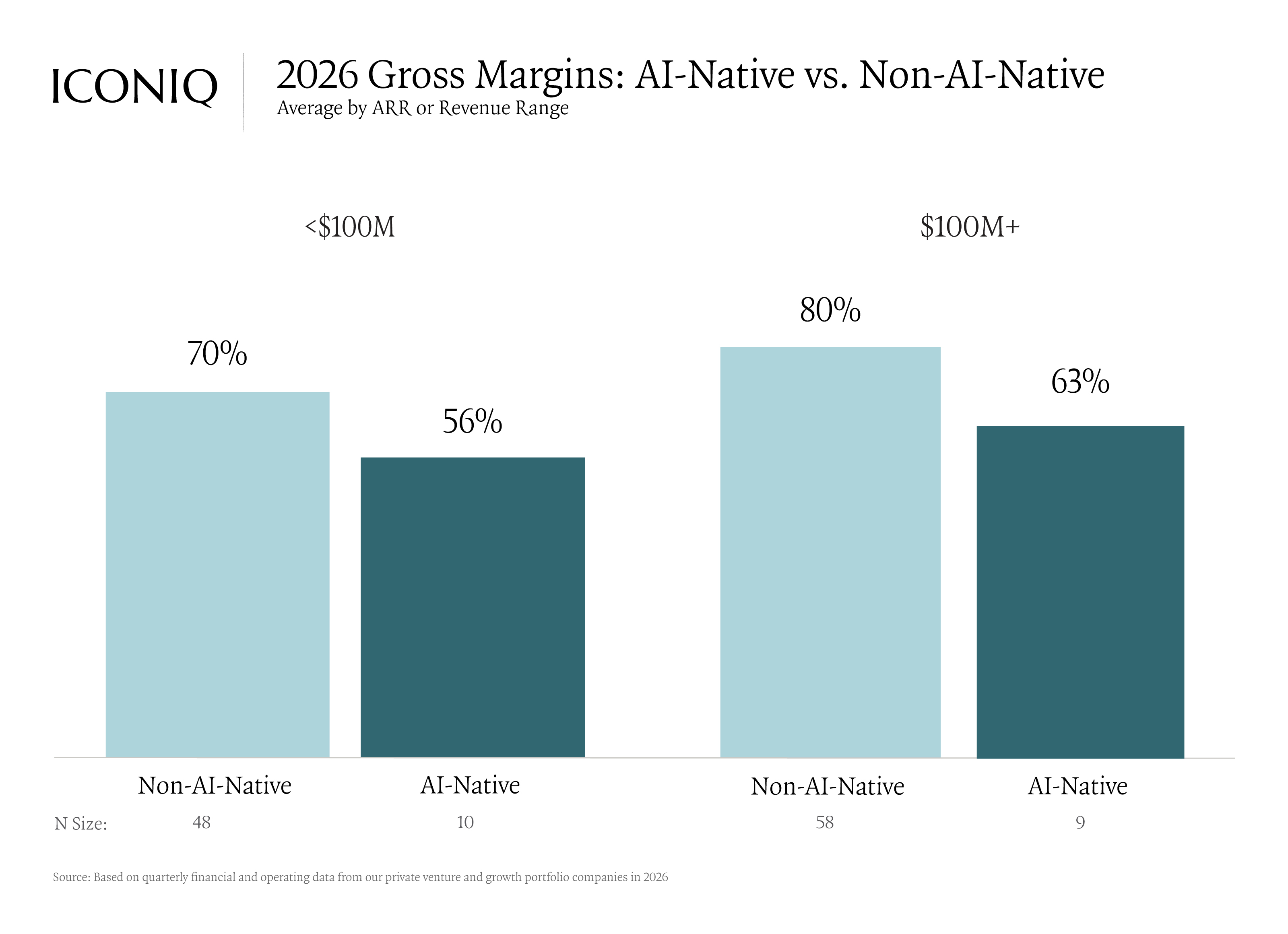
If you're running an AI-native product, you already understand the rationale for this change. Your margin isn't fixed anymore. As AI usage scales, so does token spend, and with it, COGS. Among the companies in this study, AI-native businesses, on average, run gross margins roughly 15 points lower than their non-AI-native peers: 56% versus 70% for companies under $100M in ARR, and 63% versus 80% for $100M+ ARR companies. For several operators we spoke with, closing that gap was one of the key reasons to move to consumption pricing, and those that have already moved customers over are seeing margins improve.
There's also a broader strategic benefit on the customer side. One team might run an agent a few times a week while another relies on it all day, yet seat-based pricing charges them the same. With consumption pricing, customers pay based on how much they use the product, and their spend goes up as usage grows. The tradeoff is that a variable bill is harder to budget for, so companies may need to give customers ways to keep it in check, such as enabling customers to see their usage in real time, set spending limits, and receive alerts before they hit those limits.
“Consumption-based pricing puts us on the same side of the table as our customers. They pay for the work the platform delivers, not the number of people who log in, so we only grow when we deliver real value. And with our real-time dashboard, customers can set user limits and track consumption by organization, user and project, so spend stays predictable.” - Jack Hughes, Director of Strategic Finance, Legora
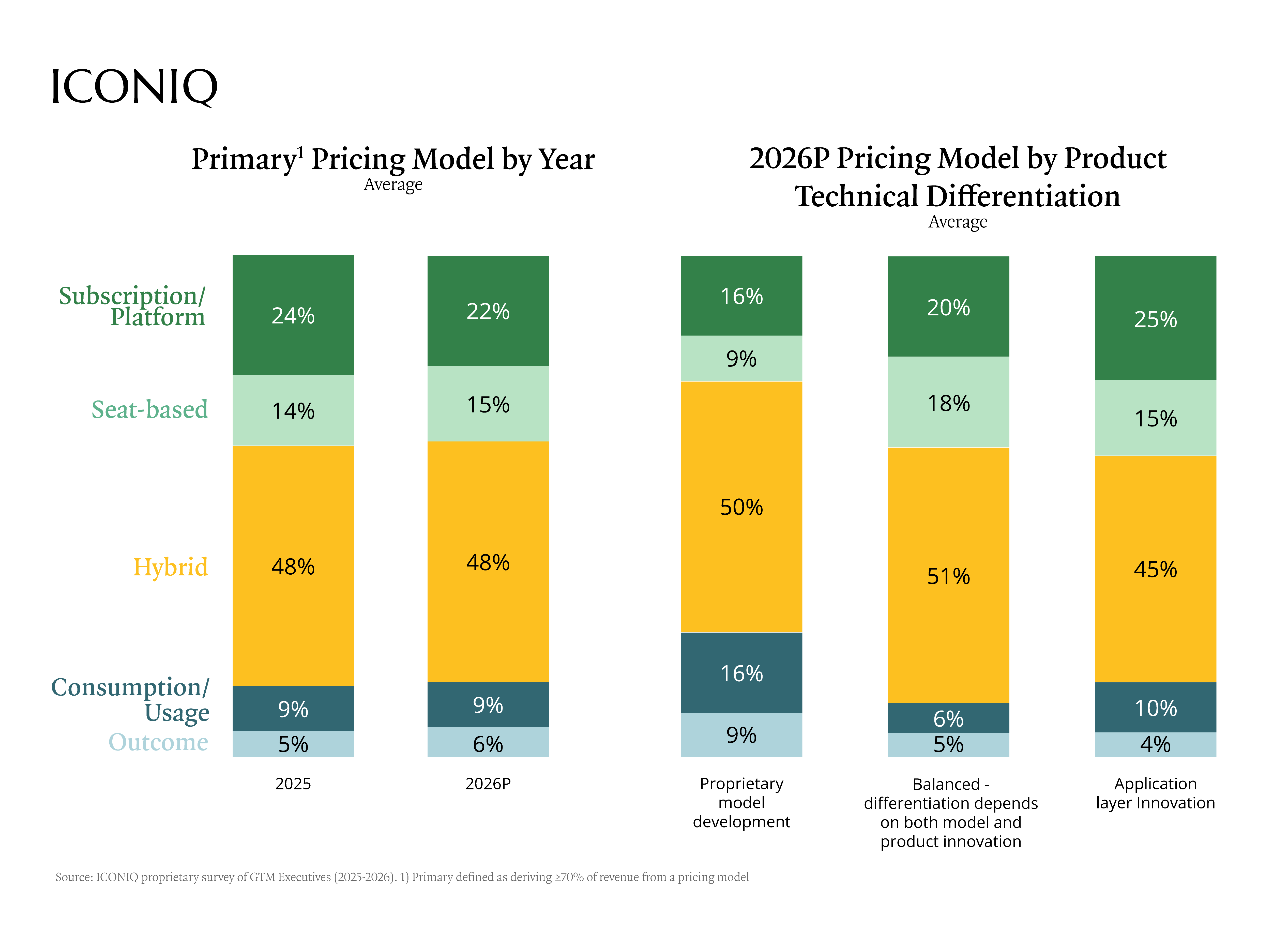
We believe Legora’s approach to introducing consumption-based pricing for a single product, backed by real-time customer visibility, reflects a broader pattern in how companies are making the shift. Hybrid pricing is now standard at roughly half the companies we surveyed, giving customers a familiar base while they get comfortable with usage-based spend. Pure consumption or outcome-based pricing is more common among companies running their products on proprietary models.
Getting this right may also change who inside your company owns pricing. Glean is a few quarters into the shift, and their Chief Financial Officer, Michael Miao, now spends much of his week on it, with his team getting pulled into those conversations much earlier than before.
"Finance used to be about keeping the lights on, running payroll, and forecasting accurately. That still exists, but it's no longer the center of gravity. Now most of my time goes to pricing: talking directly to customers about the new model, and working with product marketing on why Glean's harness is more token-efficient. Finance sits much closer to product and pricing than it did a year or two ago." - Michael Miao, Chief Financial Officer, Glean
If pricing is still owned solely by Product or Sales, it’s worth revisiting before your next planning cycle.
Where it breaks first: quotas and compensation
Across our network, one of the biggest challenges of consumption-based pricing is how to navigate the downstream, tactical implications for quotas and compensation.
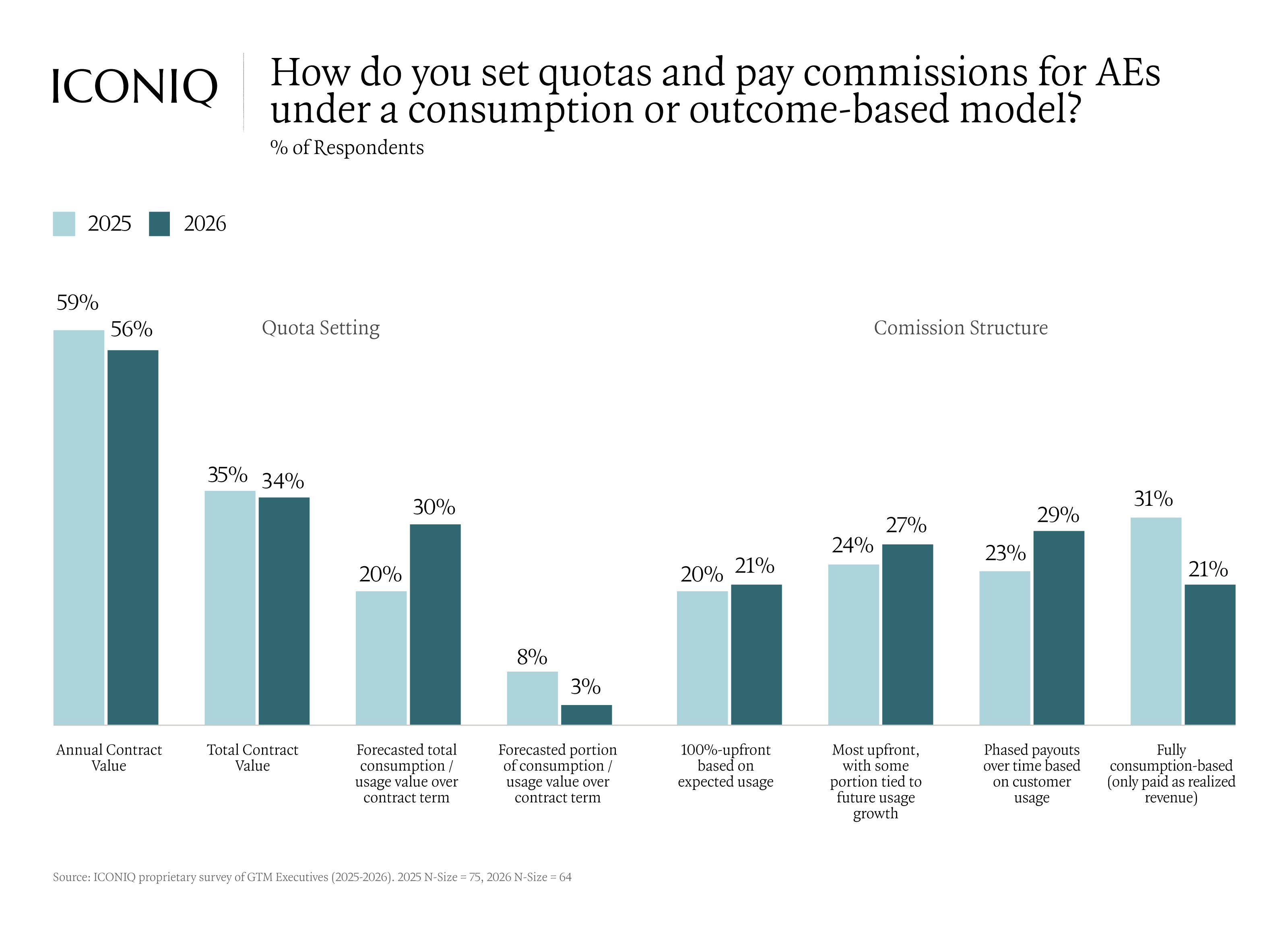
Many companies are still working this out. About half of the companies we surveyed still set quotas based on ACV from contracts with upfront commits, while 30% now set quotas off forecasted consumption, up 10 percentage points since last year. On compensation, approaches are fairly distributed, but many companies are adopting a two-step approach: an upfront payout followed by incremental payouts as customer usage grows.
In our view, the market's default instinct is that if you sell on consumption, then you should comp on consumption.
But, according to Chris Degnan, former CRO at Snowflake who helped scale the company’s revenue from $0 to over $1B, that approach is too simplistic. Compensation should map to company stage, role objectives, and the behaviors you're trying to drive. Not every role should be on a consumption plan. Start by identifying which roles and behaviors actually influence customer usage, then design compensation around those behaviors. If you decide to make the shift, phase it in over time and give sellers a clear understanding of how the new model affects their earnings.
For example, Snowflake layered in consumption, starting with bookings. Early comp ran on a $1M ACV growth quota plus a renewals quota, with accelerators gated behind eight new logos and two to three net-new meetings a week, on roughly $40K lands at 170%+ net retention. As the data matured, the renewals quota became a consumption quota, the ACV incentives stayed, and reps got daily visibility into consumption by customer. In other words, it’s only when you can truly measure consumption that you earn the right to comp on it.
Finally, in a consumption business, we believe it’s important to remember that the person closest to whether usage is growing isn’t always the one who closed the deal. Solution engineers and technical account teams could carry comp tied to both bookings and consumption, with the technical side owning the use-case roadmap. Everyone who influences usage, not just sellers, could have incentives tied to growing it.
The part that shows up in your board deck: forecasting
Usage revenue is hard to forecast by hand, and the operators who've lived through it gave the same advice: stop asking a person to do it.
Two things stood out during our discussion with Chris Degnan:
- First, attribution often has a ceiling. A roughly 70% fidelity rate is often the practical limit for connecting sales activity and use cases to downstream consumption. Rather than chasing perfect attribution, companies may be better served aligning managers on the right leading indicators.
- Second, product and engineering can move consumption in ways revenue never sees coming. Snowflake learned this the hard way: a routine performance improvement once cut a hundred million dollars from the forecast overnight, with no warning from anywhere in GTM. That experience led them to start with cohort-based forecasting and gradually evolve to customer-level forecasting as more usage data became available.
Consistent with both takeaways, operators told us ML models tend to forecast usage better than people. Hold sales accountable for what they can actually influence, like use cases won and go-live timelines, rather than a usage number they don't control.
Ultimately, we believe the companies doing this well treat usage telemetry as a product capability, not a RevOps project.
"If product and engineering leaders don't understand why that data matters to revenue, that's a CEO problem, not a RevOps one." - Chris Degnan, former CRO, Snowflake and ICONIQ GTM Advisor
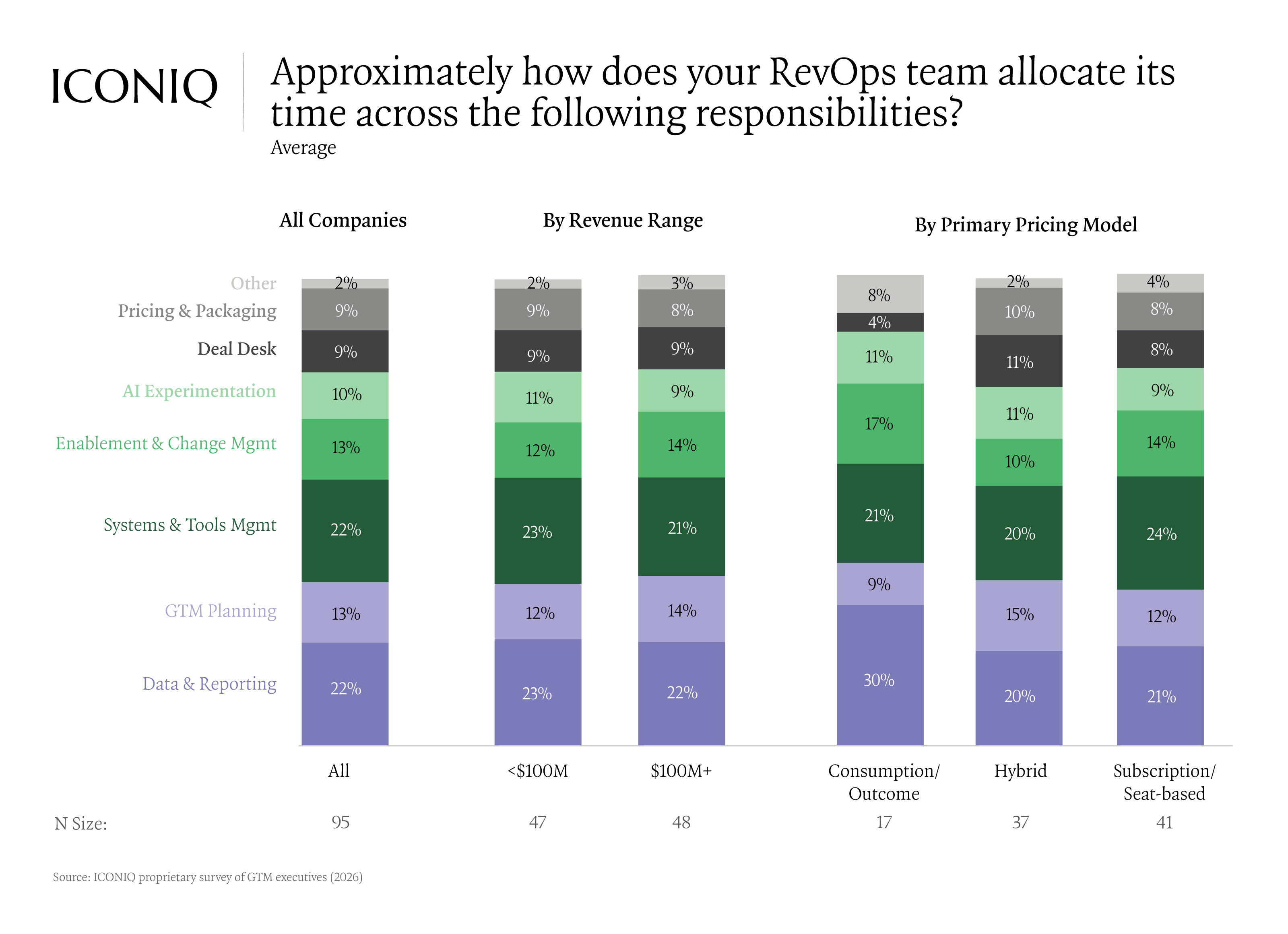
You can already see this materialize in where RevOps teams spend their time. Across the companies we surveyed, RevOps at consumption-model companies spends close to 30% of its time on data and reporting, versus 21% at seat-based and subscription-based companies. And while RevOps typically sits under Sales, it is also relatively common for RevOps to report into Finance at companies with consumption- or outcome-based pricing models. That's likely to become even more common as more companies mature their consumption pricing.
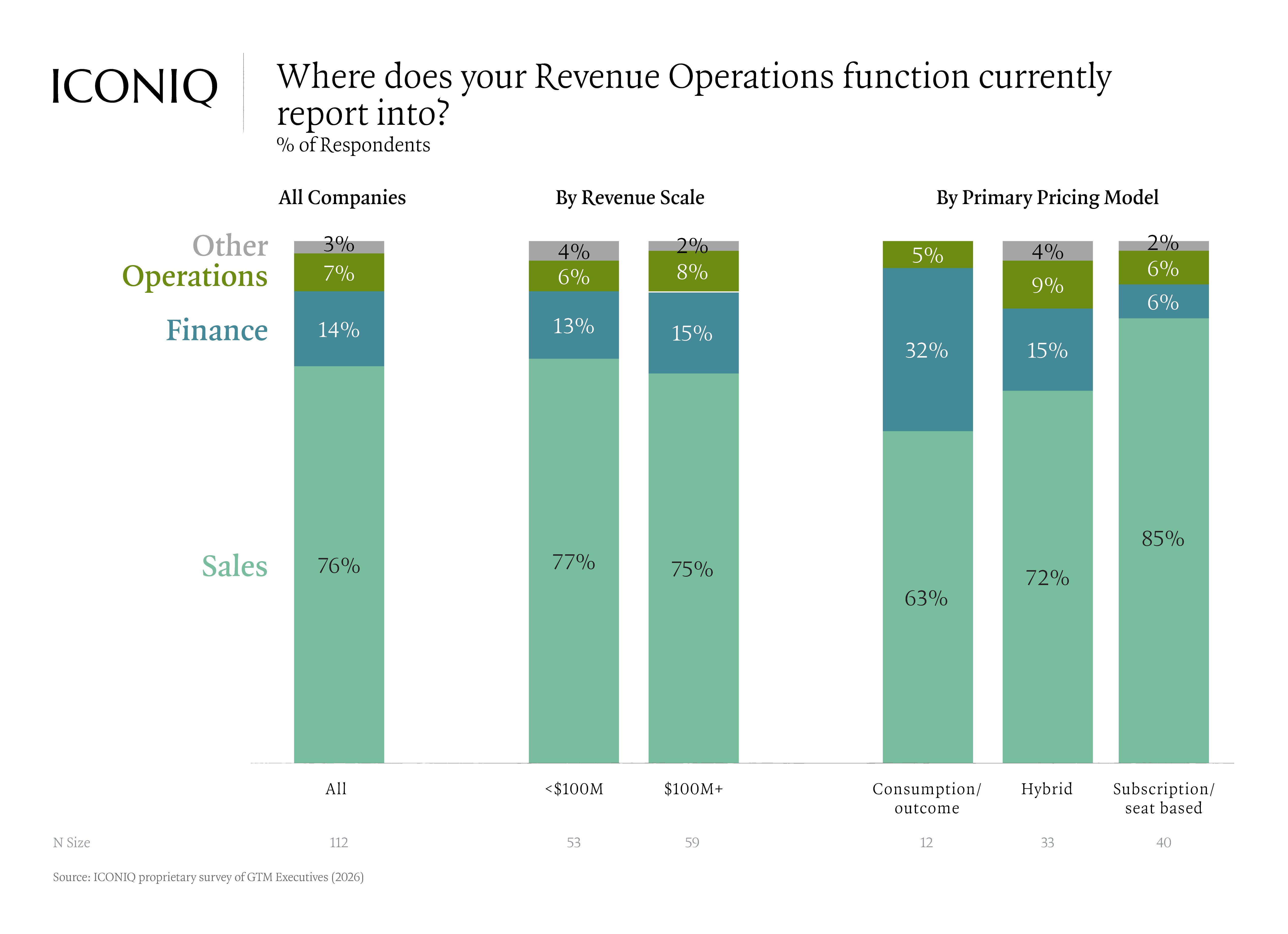
The operators who've actually built this infrastructure advise treating RevOps like a product team: own the customer lifecycle end-to-end, and make a deliberate call on what to build versus buy instead of defaulting to either.
Buy when a vendor has data, network effects, or capability you couldn't realistically replicate.
Build when the use case is specific to your motion and you're honestly prepared to support it well after launch, not just ship it.
That last part is where many teams underestimate the cost. AI has made the first build much cheaper, but the work after launch still takes real people and real time. Maintenance, bug fixes, user support, and documentation don’t disappear, and a tool that takes a week to build can require ongoing time and resources to maintain.
Where this leaves leadership teams
Moving to consumption pricing is a significant undertaking in its own right. But as the operators we spoke with clearly state, the work doesn't end when the new pricing model launches. In many ways, that's when the bigger operational changes begin.
The companies that may get it right treat metering, comp, and forecasting as one connected system, owned jointly across product, finance, and revenue, and built with their customers in mind.
Before your next planning cycle, ask yourself:
- Are customers equipped to understand and manage usage-based spending?
- Do product and engineering teams understand how their decisions affect revenue?
- Are compensation changes keeping pace with the maturity of our usage data?
- Are we investing in usage telemetry as core infrastructure, rather than patching it together after the fact?
Consumption pricing may begin with a change in how customers pay. In our view, making it work requires a change in how the entire company operates.
Published:
November 2, 2026