

The State ofGo-to-Marketin 2025

AI is fundamentally reshaping how organizations approach growth. As businesses navigate this transformation, they're rapidly redefining their go-to-market (GTM) strategies, from team structures to execution plans, to stay competitive.
In our 2025 State of GTM report, we dive into how leading companies are adapting. We explore critical GTM health indicators, strategic shifts, and the transformative impact AI adoption is having across teams.
GTM Health: Emerging Signs of Reacceleration
Overall, year-over-year ARR growth has remained relatively flat since 2023. However, we're now seeing early signs of reacceleration, particularly among companies in the $25M-$200M ARR range. Notably, AI-Native companies are significantly outpacing their Non-AI-Native peers when it comes to topline growth.
Part of the stagnation can be attributed to weaknesses deeper in the sales funnel as many companies are struggling to convert late-stage opportunities into Closed-Won deals. AI-Native companies, on the other hand, are driving stronger conversion rates through free trials and proof-of-concept programs – especially in companies with $100M+ ARR, where conversion rates average 56% compared to 32% among others.
This growth stagnation is also reflected in declining quota attainment, with a slight year-over-year drop in the percentage of reps hitting topline targets.
Key Takeaways:
- Top-quartile ARR growth among $25M-$100M ARR companies increased to 93% YTD in 2025, up from 78% in 2023
- AI-Native companies achieve significantly higher funnel conversion rates, especially from free trial/proof-of-concept phases ($100M+ ARR companies: 56% vs. 32% for others)
- Overall AE quota attainment remains flat (58% YTD in 2025 vs. 59% in 2024)


.png)
GTM Strategy: New Roles, Pricing Models, and AI Influence
High-growth Non-AI-Native companies dedicate a smaller share of GTM headcount to Post-Sales, while AI-Native companies (regardless of growth performance) allocate more headcount to Post-Sales teams. This is likely due to technical onboarding needs and the urge to drive adoption of ‘new age’ tools. In response, we’re seeing the rise of forward-deployed engineers who play a critical role in driving change management (especially in legacy, slower moving industries).
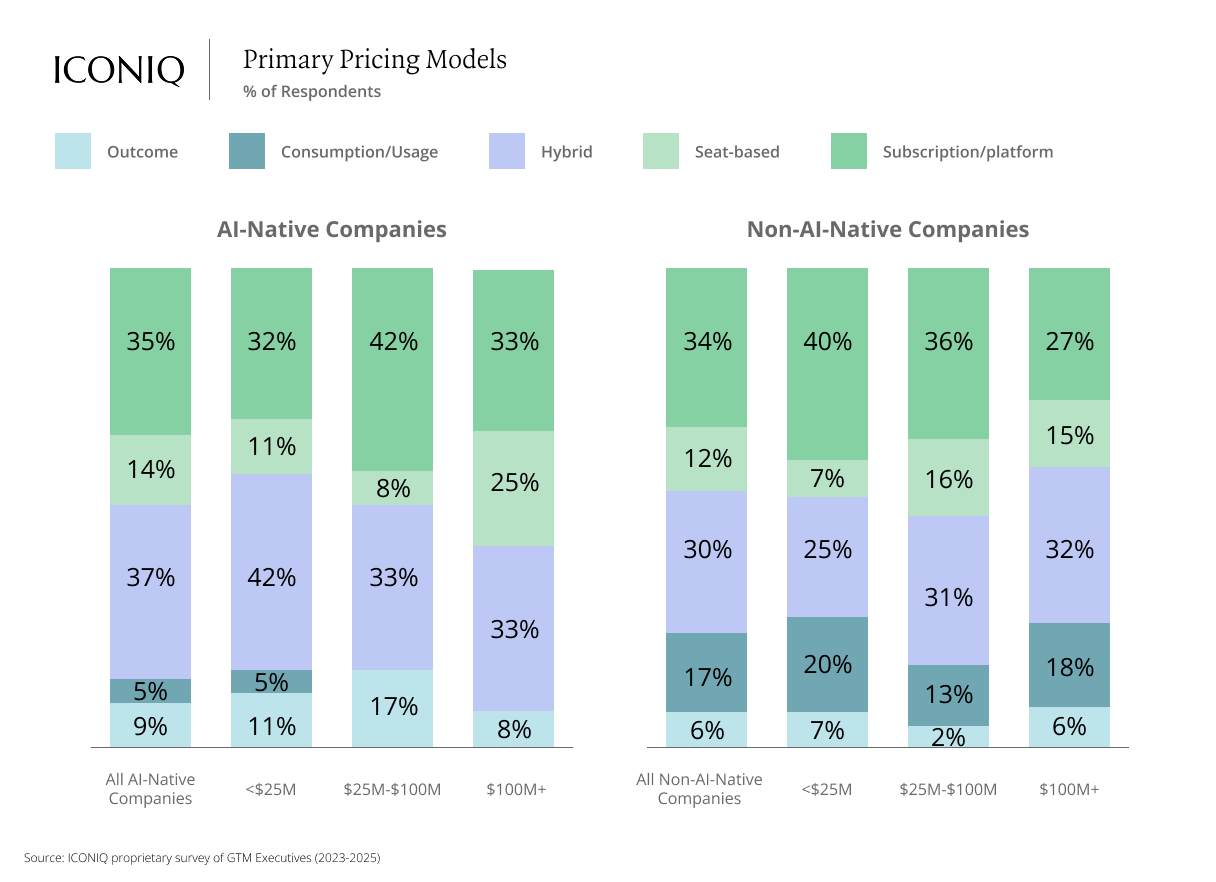
Pricing strategies are also evolving in response to shifting buyer expectations and the growing need for more value-based models. While subscription and platform-based models remain common, we’re seeing increased adoption of hybrid pricing models – a trend that’s even more prominent among AI-Native companies. We expect more pricing experimentation as cost-to-serve comes into focus and companies start to build better telemetry around AI usage and ROI.
Key Takeaways:
- Faster-growing Non-AI-Native companies have less headcount dedicated to traditional Post-Sales roles (~23%) while AI-Native companies have more (~31-34%)
- Around one-third of companies now use hybrid pricing models, particularly among AI-Native businesses
- Revenue from channel sales remains stable, accounting for ~20% of total revenue on average

AI Implementation: Driving GTM Efficiency and Productivity
AI has quickly moved from experimentation to operational necessity across many GTM organizations. Roughly 70% of companies report at least moderate AI adoption in their GTM workflows, with full adoption even more prevalent among high-growth companies.
Today, AI’s most widespread impact is in top- and mid-funnel activities. Lead generation, automated content creation, and meeting transcription and analysis are among the most commonly adopted use cases. Those with robust AI integration across GTM teams are already seeing the payoff. They are materially outperforming their peers via gains in sales efficiency and team productivity (as reflected in leaner teams).
Key Takeaways:
- 70% of companies report moderate or full AI adoption, with top use cases including: meeting transcription, lead generation, and content creation
- High AI adopters are seeing greater sales funnel conversion rates and meaningful efficiency gains, especially among companies with <$25M ARR
- Primary AI implementation challenges include tool costs, scaling deployments, and privacy/security concerns


As AI reshapes the go-to-market landscape, we believe companies that embrace AI-driven strategies and operations will be best positioned for accelerated growth and efficiency gains. Staying agile and proactively addressing AI integration challenges can differentiate market leaders from followers, making 2025 a pivotal year for GTM innovation and transformation.
Disclaimer
The views expressed in this presentation are those of ICONIQ Venture & Growth ("ICONIQ" or the "firm"), are the result of proprietary research, may be subjective, and may not be relied upon in making an investment decision.
This presentation is for general information purposes only and does not constitute investment advice. This presentation must not be relied upon in connection with any investment decision. The information in this presentation is not intended to and does not constitute financial, accounting, tax, legal, investment, consulting or other professional advice or services. Nothing in this presentation is or should be construed as an offer, invitation or solicitation to engage in any investment activity or transaction, including an offer to sell or a solicitation of an offer to buy any securities which should only be made pursuant to definitive offering documents and subscription agreements, including without limitation, any investment fund or investment product referenced herein.
Any reproduction or distribution of this presentation in whole or in part, or the disclosure of any of its contents, without the prior consent of ICONIQ, is strictly unauthorized.
This presentation may contain forward-looking statements based on current plans, estimates and projections. The recipient of this presentation ("you") are cautioned that a number of important factors could cause actual results or outcomes to differ materially from those expressed in, or implied by, the forward-looking statements. The numbers, figures and case studies included in this presentation have been included for purposes of illustration only, and no assurance can be given that the actual results of ICONIQ or any of its partners and affiliates will correspond with the results contemplated in the presentation. No information is contained herein with respect to conflicts of interest, which may be significant. The portfolio companies and other parties mentioned herein may reflect a selective list of the prior investments made by ICONIQ.
Certain of the economic and market information contained herein may have been obtained from published sources and/or prepared by other parties. While such sources are believed to be reliable, none of ICONIQ or any of its affiliates and partners, employees and representatives assume any responsibility for the accuracy of such information.
All of the information in the presentation is presented as of the date made available to you (except as otherwise specified), and is subject to change without notice, and may not be current or may have changed (possibly materially) between the date made available to you and the date actually received or reviewed by you. ICONIQ assumes no obligation to update or otherwise revise any information, projections, forecasts or estimates contained in the presentation, including any revisions to reflect changes in economic or market conditions or other circumstances arising after the date the items were made available to you or to reflect the occurrence of unanticipated events.
For avoidance of doubt, ICONIQ is not acting as an adviser or fiduciary in any respect in connection with providing this presentation and no relationship shall arise between you and ICONIQ as a result of this presentation being made available to you.
ICONIQ is a diversified financial services firm and has direct client relationships with persons that may become limited partners of ICONIQ funds. Notwithstanding that a person may be referred to herein as a "client" of the firm, no limited partner of any fund will, in its capacity as such, be a client of ICONIQ. There can be no assurance that the investments made by any ICONIQ fund will be profitable or will equal the performance of prior investments made by persons described in this presentation.
Any information in this presentation is directed at, and intended for, only persons who are experienced institutional or professional investors (“professional investors”) as defined by applicable law and regulation. Any person that is not a professional investor is not an intended recipient of this presentation and the matters discussed herein.
ICONIQ is a trading name of certain ICONIQ Partners (UK) LLP. ICONIQ Partners (UK) LLP (Registration Number: 973080) is an appointed representative of Kroll Securities Ltd. (Registration Number: 466588) which is authorised and regulated by the Financial Conduct Authority. ICONIQ Partners (UK) LLP is a limited liability partnership whose members are ICONIQ Capital (UK) Ltd, Seth Pierrepont and Lou Thorne, and it is registered in England and Wales and has its registered office at 27 Soho Square, London W1D 3QR. ICONIQ Partners (UK) LLP acts as an adviser to ICONIQ Capital LLC
Unless otherwise indicated, the views expressed in this presentation are those of ICONIQ Venture and Growth (“ICONIQ" or the “Firm"), are the result of proprietary research, may be subjective, and may not be relied upon in making an investment decision. Information used in this presentation was obtained from numerous sources. Certain of these companies are portfolio companies of ICONIQ Venture and Growth. ICONIQ Venture and Growth does not make any representations or warranties as to the accuracy of the information obtained from these sources.
This presentation is for general information purposes only and does not constitute investment advice. This presentation must not be relied upon in connection with any investment decision. The information in this presentation is not intended to and does not constitute financial, accounting, tax, legal, investment, consulting or other professional advice or services. Nothing in this presentation is or should be construed as an offer, invitation or solicitation to engage in any investment activity or transaction, including an offer to sell or a solicitation of an offer to buy any securities which should only be made pursuant to definitive offering documents and subscription agreements, including without limitation, any investment fund or investment product referenced herein.
Any reproduction or distribution of this presentation in whole or in part, or the disclosure of any of its contents, without the prior consent of ICONIQ, is strictly unauthorized.
This presentation may contain forward-looking statements based on current plans, estimates and projections. The recipient of this presentation ("you") are cautioned that a number of important factors could cause actual results or outcomes to differ materially from those expressed in, or implied by, the forward-looking statements. The numbers, figures and case studies included in this presentation have been included for purposes of illustration only, and no assurance can be given that the actual results of ICONIQ or any of its partners and affiliates will correspond with the results contemplated in the presentation. No information is contained herein with respect to conflicts of interest, which may be significant. The portfolio companies and other parties mentioned herein may reflect a selective list of the prior investments made by ICONIQ.
Certain of the economic and market information contained herein may have been obtained from published sources and/or prepared by other parties. While such sources are believed to be reliable, none of ICONIQ or any of its affiliates and partners, employees and representatives assume any responsibility for the accuracy of such information.
All of the information in the presentation is presented as of the date made available to you (except as otherwise specified), and is subject to change without notice, and may not be current or may have changed (possibly materially) between the date made available to you and the date actually received or reviewed by you. ICONIQ assumes no obligation to update or otherwise revise any information, projections, forecasts or estimates contained in the presentation, including any revisions to reflect changes in economic or market conditions or other circumstances arising after the date the items were made available to you or to reflect the occurrence of unanticipated events. Numbers or amounts herein may increase or decrease as a result of currency fluctuations.
For avoidance of doubt, ICONIQ is not acting as an adviser or fiduciary in any respect in connection with providing this presentation and no relationship shall arise between you and ICONIQ as a result of this presentation being made available to you.
ICONIQ is a diversified financial services firm and has direct client relationships with persons that may become limited partners of ICONIQ funds. Notwithstanding that a person may be referred to herein as a "client" of the firm, no limited partner of any fund will, in its capacity as such, be a client of ICONIQ. There can be no assurance that the investments made by any ICONIQ fund will be profitable or will equal the performance of prior investments made by persons described in this presentation.
Any information in this presentation is directed at, and intended for, only persons who are experienced institutional or professional investors (“professional investors”) as defined by applicable law and regulation. Any person that is not a professional investor is not an intended recipient of this presentation and the matters discussed herein.
ICONIQ is a trading name of ICONIQ Partners (UK) LLP. ICONIQ Partners (UK) LLP (Registration Number: 973080) is an appointed representative of Kroll Securities Ltd. (Registration Number: 466588) which is authorised and regulated by the Financial Conduct Authority. ICONIQ Partners (UK) LLP is a limited liability partnership whose members are ICONIQ Capital (UK) Ltd, Seth Pierrepont and Lou Thorne, and it is registered in England and Wales and has its registered office at 27 Soho Square, London W1D 3QR. ICONIQ Partners (UK) LLP acts as an adviser to ICONIQ Capital LLC