
%20(1).avif)
2025 State of AI Report: The Builder’s Playbook
A Practical Roadmap for AI Innovation
1. AI Product Strategy Has Entered the Next Maturity Curve
2. Evolving Monetization Models Reflect AI’s Unique Economics
3. Talent Strategy Is a Differentiator
4. AI Budgets Are Increasing Fast and Showing Up in Real P&L Terms
5. Internal AI Adoption Is Expanding, But Not Evenly
Final Thoughts

AI has entered a new chapter: from hype to hands-on. Creating and scaling AI products is becoming the pivotal arena for competitive edge. Our 2025 State of AI report, The Builder’s Playbook, shifts focus from AI adoption to the how-to of AI execution, unpacking what it takes to conceive, deliver, and scale AI-powered offerings end-to-end.
Drawing on proprietary April 2025 survey results of 300 executives at software companies and in-depth interviews with AI leaders across the ICONIQ community1, this report offers a tactical roadmap for translating generative AI intelligence into a durable business advantage.
Across all dimensions - from infrastructure to GTM and talent - we believe the leading AI builders are defined not just by model sophistication, but by their strategic agility, cost discipline, and willingness to experiment fast.
Below, we break down five key chapters from the report and what they mean for teams actively building with AI.
1. AI Product Strategy Has Entered the Next Maturity Curve
AI-first companies are moving much more quickly to get their products to market compared to those just adding AI to existing offerings. In fact, nearly half (47%) of AI-native companies have reached critical scale and proven market fit, compared with just 13% of companies building AI-enabled products.
What they’re building: Agentic workflows and vertical applications dominate. Nearly 80% of AI-native builders are investing in agentic workflows, or autonomous systems designed to take multi-step actions on behalf of users.
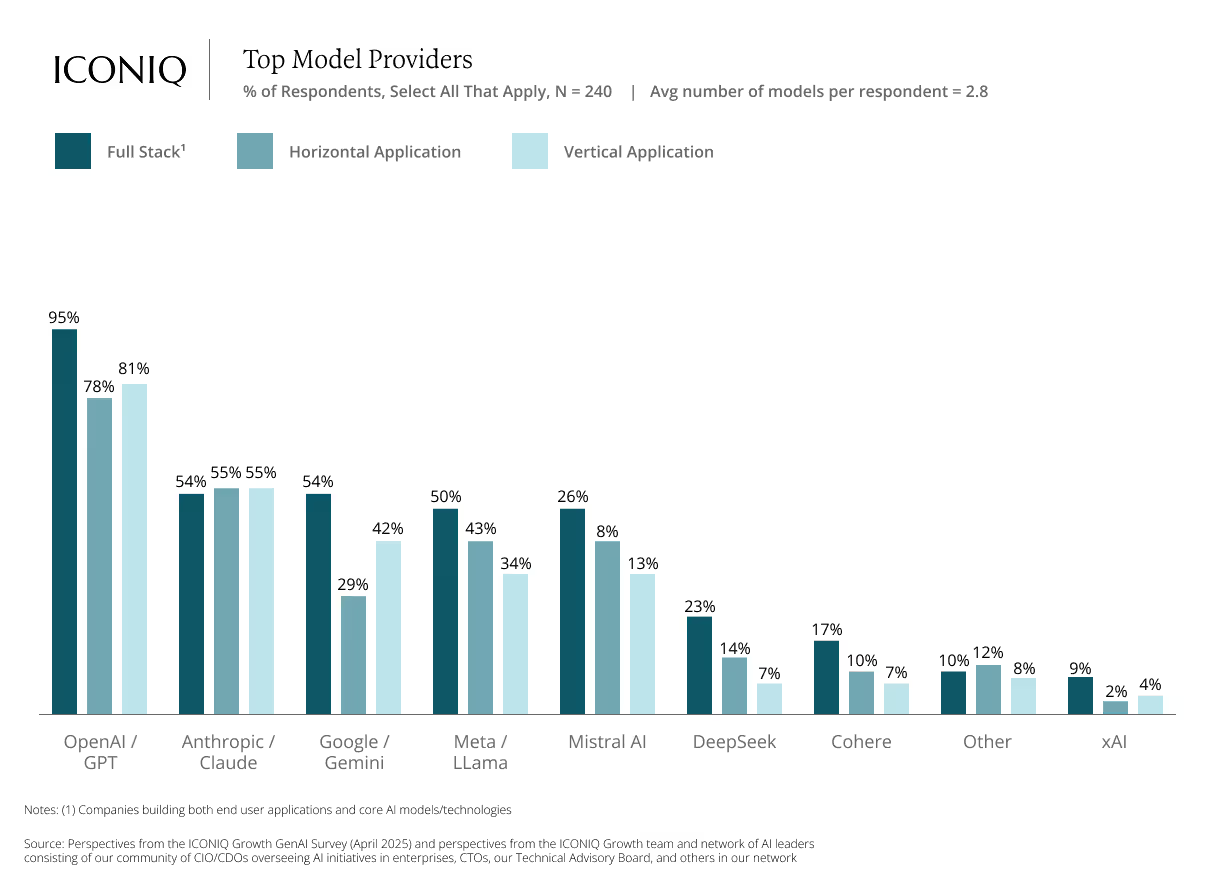
How they’re building: Companies are converging on multi-model architectures to optimize for performance, cost, and use case specificity, with 2.8 models used on average per respondent for customer-facing products.


.png)
2. Evolving AI Pricing Models Reflect Unique Economics
AI is changing how companies set prices for their products and services. According to our survey, many are now using hybrid pricing models, combining a basic subscription with charges based on how much you use. Some companies are even experimenting with pricing completely based on usage or the actual results customers achieve.
While a good number of companies currently include AI features for free, more than one-third (37%) plan to adjust their pricing in the next year, to better reflect the value customers get and how much they’re using the AI features.
.png)

3. Talent Strategy as a Differentiator
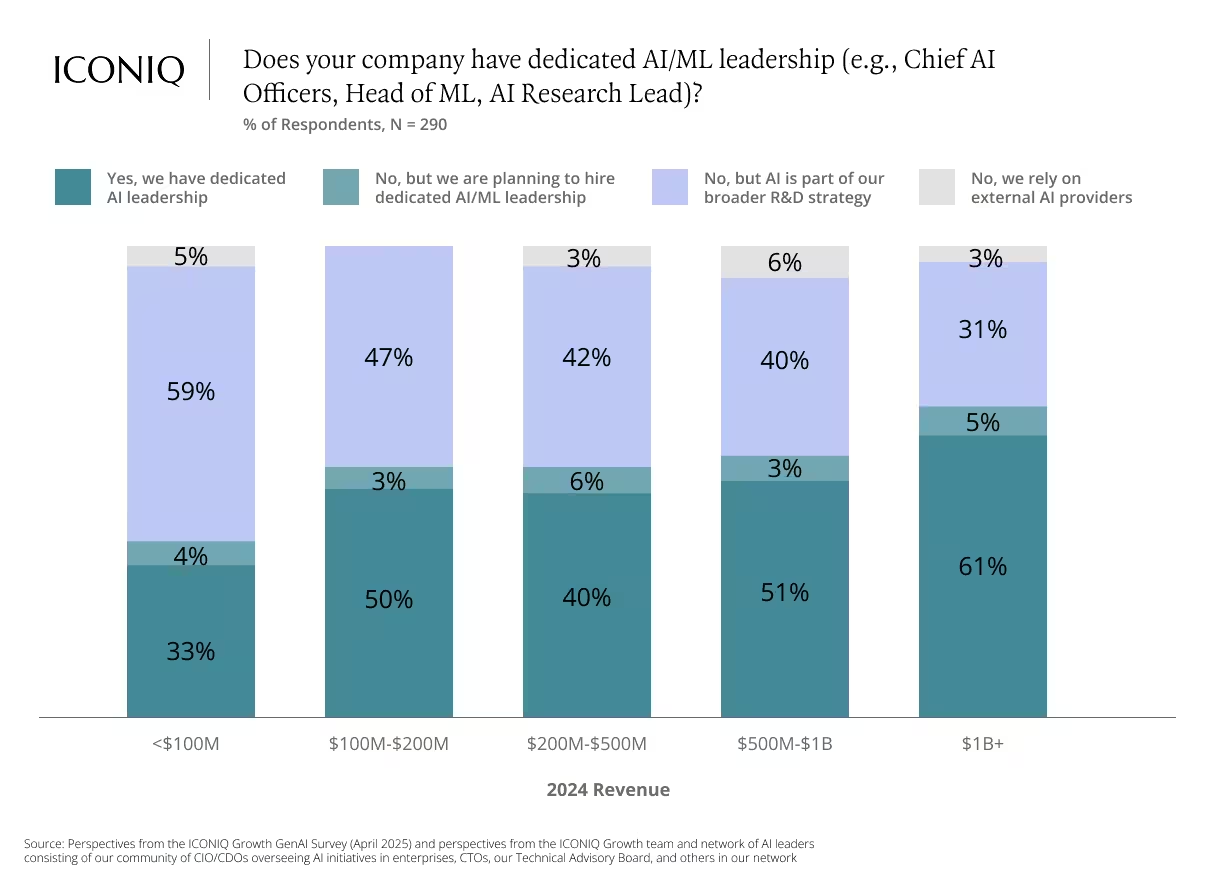
AI is not just a technology problem. It is an organizational one. Most top builders are assembling cross-functional teams with AI/ML engineers, data scientists, and AI product managers.
Looking ahead, most organizations expect 20-30% of their engineering team to be focused on AI, with high-growth companies projecting up to 37%. But survey results show that finding the right talent remains a bottleneck. AI/ML engineers take the longest to hire of any AI-specific role, with an average time-to-fill exceeding 70 days.
Sentiment around the pace of hiring is split. While some feel they’re on track, 54% report falling behind, most often due to a limited pool of qualified candidates.

4. AI Budgets Are Increasing Fast and Showing Up in Real P&L Terms
AI-enabled companies are allocating 10-20% of R&D budgets to AI development. That number is growing across every revenue band in 2025. This shift underscores just how central AI has become to product strategy.
As AI products scale, the cost mix often shifts. In the early stages of product development, talent is generally the biggest expense - this includes hiring, training, and upskilling. But as products mature, cloud costs, model inference, and governance start to make up the majority of spend.


5. Internal AI Adoption Is Expanding, But Not Evenly
Internal use of AI is growing fast, but not everywhere equally. Even though most companies surveyed give around 70% of their employees access to internal AI tools, only about half actually use them regularly. Getting employees to adopt AI is particularly tough in larger, more established businesses.
What works? High-adoption organizations, where 50% or more of employees use AI tools, deploy AI across seven or more internal use cases on average. These include coding assistants (used by 77% of respondents), content generation (65%), and documentation search (57%). Productivity gains range from 15 to 30% in these areas.


The AI Tooling Ecosystem Is Fragmented but Maturing
We surveyed hundreds of companies to understand which frameworks, libraries, and platforms are running in production today. The result isn’t a ranking. It’s a real-world snapshot of the tools developers are using across categories.
Below, you’ll find a quick tour of the most widely used tools in alphabetical order. If you’re building something different or doubling down on a rising alternative, we’d love to hear from you: ICONIQGrowthInsights@iconiqcapital.com.
.jpg)
[1] Survey responses include some but not all ICONIQ Venture and Growth portfolio companies as well as companies not part of ICONIQ Venture and Growth’s portfolio. Please refer to the full report for additional information here.
Disclaimer
The views expressed in this presentation are those of ICONIQ Venture & Growth ("ICONIQ" or the "firm"), are the result of proprietary research, may be subjective, and may not be relied upon in making an investment decision.
This presentation is for general information purposes only and does not constitute investment advice. This presentation must not be relied upon in connection with any investment decision. The information in this presentation is not intended to and does not constitute financial, accounting, tax, legal, investment, consulting or other professional advice or services. Nothing in this presentation is or should be construed as an offer, invitation or solicitation to engage in any investment activity or transaction, including an offer to sell or a solicitation of an offer to buy any securities which should only be made pursuant to definitive offering documents and subscription agreements, including without limitation, any investment fund or investment product referenced herein.
Any reproduction or distribution of this presentation in whole or in part, or the disclosure of any of its contents, without the prior consent of ICONIQ, is strictly unauthorized.
This presentation may contain forward-looking statements based on current plans, estimates and projections. The recipient of this presentation ("you") are cautioned that a number of important factors could cause actual results or outcomes to differ materially from those expressed in, or implied by, the forward-looking statements. The numbers, figures and case studies included in this presentation have been included for purposes of illustration only, and no assurance can be given that the actual results of ICONIQ or any of its partners and affiliates will correspond with the results contemplated in the presentation. No information is contained herein with respect to conflicts of interest, which may be significant. The portfolio companies and other parties mentioned herein may reflect a selective list of the prior investments made by ICONIQ.
Certain of the economic and market information contained herein may have been obtained from published sources and/or prepared by other parties. While such sources are believed to be reliable, none of ICONIQ or any of its affiliates and partners, employees and representatives assume any responsibility for the accuracy of such information.
All of the information in the presentation is presented as of the date made available to you (except as otherwise specified), and is subject to change without notice, and may not be current or may have changed (possibly materially) between the date made available to you and the date actually received or reviewed by you. ICONIQ assumes no obligation to update or otherwise revise any information, projections, forecasts or estimates contained in the presentation, including any revisions to reflect changes in economic or market conditions or other circumstances arising after the date the items were made available to you or to reflect the occurrence of unanticipated events.
For avoidance of doubt, ICONIQ is not acting as an adviser or fiduciary in any respect in connection with providing this presentation and no relationship shall arise between you and ICONIQ as a result of this presentation being made available to you.
ICONIQ is a diversified financial services firm and has direct client relationships with persons that may become limited partners of ICONIQ funds. Notwithstanding that a person may be referred to herein as a "client" of the firm, no limited partner of any fund will, in its capacity as such, be a client of ICONIQ. There can be no assurance that the investments made by any ICONIQ fund will be profitable or will equal the performance of prior investments made by persons described in this presentation.
Any information in this presentation is directed at, and intended for, only persons who are experienced institutional or professional investors (“professional investors”) as defined by applicable law and regulation. Any person that is not a professional investor is not an intended recipient of this presentation and the matters discussed herein.
ICONIQ is a trading name of certain ICONIQ Partners (UK) LLP. ICONIQ Partners (UK) LLP (Registration Number: 973080) is an appointed representative of Kroll Securities Ltd. (Registration Number: 466588) which is authorised and regulated by the Financial Conduct Authority. ICONIQ Partners (UK) LLP is a limited liability partnership whose members are ICONIQ Capital (UK) Ltd, Seth Pierrepont and Lou Thorne, and it is registered in England and Wales and has its registered office at 27 Soho Square, London W1D 3QR. ICONIQ Partners (UK) LLP acts as an adviser to ICONIQ Capital LLC
Unless otherwise indicated, the views expressed in this presentation are those of ICONIQ Venture and Growth (“ICONIQ" or the “Firm"), are the result of proprietary research, may be subjective, and may not be relied upon in making an investment decision. Information used in this presentation was obtained from numerous sources. Certain of these companies are portfolio companies of ICONIQ Venture and Growth. ICONIQ Venture and Growth does not make any representations or warranties as to the accuracy of the information obtained from these sources.
This presentation is for general information purposes only and does not constitute investment advice. This presentation must not be relied upon in connection with any investment decision. The information in this presentation is not intended to and does not constitute financial, accounting, tax, legal, investment, consulting or other professional advice or services. Nothing in this presentation is or should be construed as an offer, invitation or solicitation to engage in any investment activity or transaction, including an offer to sell or a solicitation of an offer to buy any securities which should only be made pursuant to definitive offering documents and subscription agreements, including without limitation, any investment fund or investment product referenced herein.
Any reproduction or distribution of this presentation in whole or in part, or the disclosure of any of its contents, without the prior consent of ICONIQ, is strictly unauthorized.
This presentation may contain forward-looking statements based on current plans, estimates and projections. The recipient of this presentation ("you") are cautioned that a number of important factors could cause actual results or outcomes to differ materially from those expressed in, or implied by, the forward-looking statements. The numbers, figures and case studies included in this presentation have been included for purposes of illustration only, and no assurance can be given that the actual results of ICONIQ or any of its partners and affiliates will correspond with the results contemplated in the presentation. No information is contained herein with respect to conflicts of interest, which may be significant. The portfolio companies and other parties mentioned herein may reflect a selective list of the prior investments made by ICONIQ.
Certain of the economic and market information contained herein may have been obtained from published sources and/or prepared by other parties. While such sources are believed to be reliable, none of ICONIQ or any of its affiliates and partners, employees and representatives assume any responsibility for the accuracy of such information.
All of the information in the presentation is presented as of the date made available to you (except as otherwise specified), and is subject to change without notice, and may not be current or may have changed (possibly materially) between the date made available to you and the date actually received or reviewed by you. ICONIQ assumes no obligation to update or otherwise revise any information, projections, forecasts or estimates contained in the presentation, including any revisions to reflect changes in economic or market conditions or other circumstances arising after the date the items were made available to you or to reflect the occurrence of unanticipated events. Numbers or amounts herein may increase or decrease as a result of currency fluctuations.
For avoidance of doubt, ICONIQ is not acting as an adviser or fiduciary in any respect in connection with providing this presentation and no relationship shall arise between you and ICONIQ as a result of this presentation being made available to you.
ICONIQ is a diversified financial services firm and has direct client relationships with persons that may become limited partners of ICONIQ funds. Notwithstanding that a person may be referred to herein as a "client" of the firm, no limited partner of any fund will, in its capacity as such, be a client of ICONIQ. There can be no assurance that the investments made by any ICONIQ fund will be profitable or will equal the performance of prior investments made by persons described in this presentation.
Any information in this presentation is directed at, and intended for, only persons who are experienced institutional or professional investors (“professional investors”) as defined by applicable law and regulation. Any person that is not a professional investor is not an intended recipient of this presentation and the matters discussed herein.
ICONIQ is a trading name of ICONIQ Partners (UK) LLP. ICONIQ Partners (UK) LLP (Registration Number: 973080) is an appointed representative of Kroll Securities Ltd. (Registration Number: 466588) which is authorised and regulated by the Financial Conduct Authority. ICONIQ Partners (UK) LLP is a limited liability partnership whose members are ICONIQ Capital (UK) Ltd, Seth Pierrepont and Lou Thorne, and it is registered in England and Wales and has its registered office at 27 Soho Square, London W1D 3QR. ICONIQ Partners (UK) LLP acts as an adviser to ICONIQ Capital LLC