.jpg)
Introducing the ICONIQ Pacesetter Index
Before the widespread adoption of AI, we built the ICONIQ Enterprise Five Scorecard: five metrics benchmarked against historical data that sought to capture what it took to build a durable software company at scale. Those fundamentals still hold, but a new generation of companies is setting the pace today against a different backdrop than the one our Enterprise Five was built to measure.
First, the benchmark for scaling successfully has changed. The ICONIQ Enterprise Five measured historical and aggregate performance across the software universe, giving us a view of where the broad market was landing. Some of today’s leading companies sit well above the aggregate medians and even top quartile figures. So, identifying top performing companies means benchmarking against them, not the broader market.
Second, the economics of software have evolved. AI is reshaping both what software does and how companies monetize it. Products are increasingly taking on end-to-end tasks once performed by people, allowing usage to scale far beyond the number of seats purchased. As a result, monetization strategies have shifted to better reflect both the cost to build AI products and the value they create for customers. Together, these product and monetization shifts have reshaped how companies scale in ways the original Enterprise Five was not designed to measure.
That is why the ICONIQ Enterprise Five is evolving into the ICONIQ Pacesetter Index.
How We Define the ICONIQ Pacesetter Index
The ICONIQ Pacesetter Index keeps the core of the Enterprise Five while refining how we benchmark the companies setting today’s performance standard.
- Who's included: AI-forward companies with revenue growth in at least the top quartile for their scale range
- The timeframe: The past three years, keeping benchmarks current and more representative of some of today’s leading companies
- The metrics: The fundamentals that continue to signal durable growth and efficiency, alongside additional metrics that are increasingly important in an AI-driven market
The ICONIQ Pacesetter Index
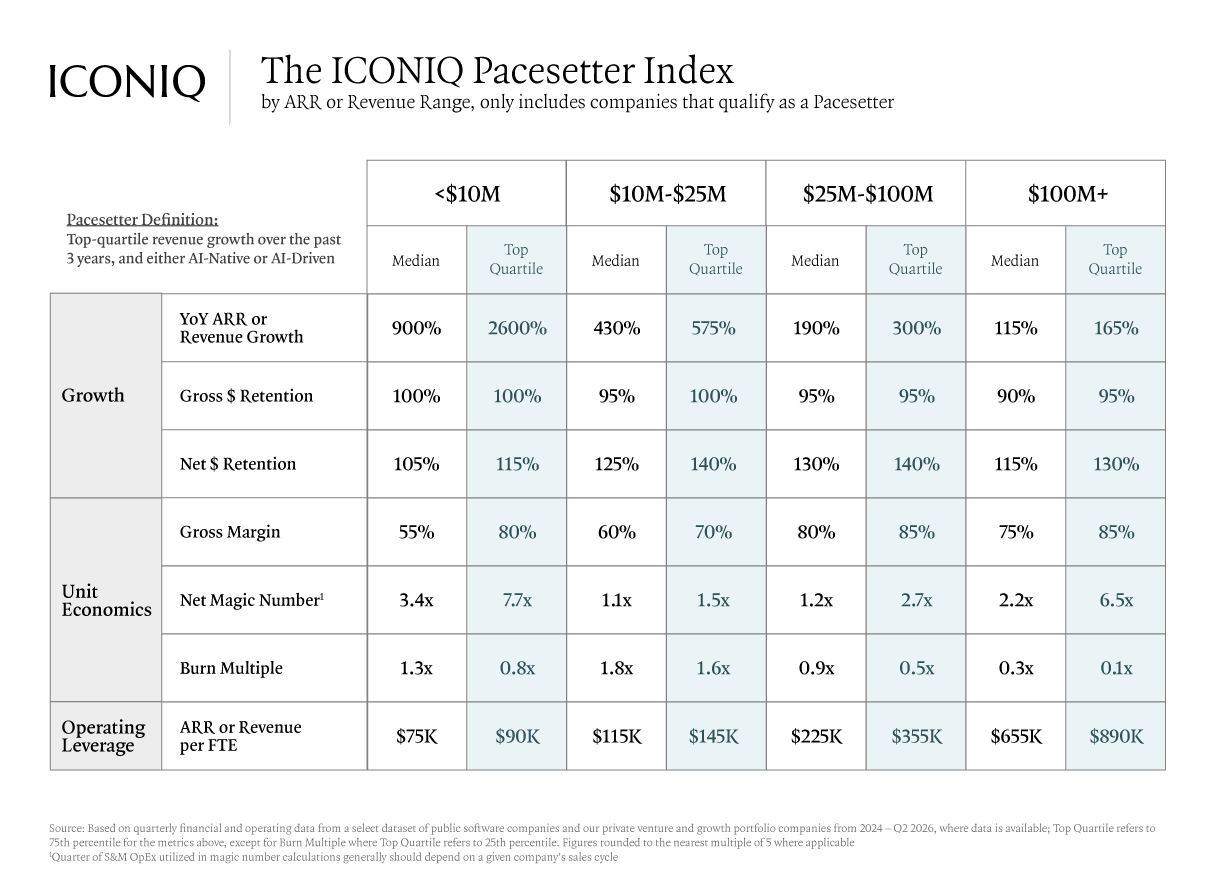
What These Metrics Mean for Today’s Pacesetters
- Revenue Growth: AI is making growth increasingly unbounded as products deliver value faster, adoption spreads more quickly, expansion compounds within accounts, and monetization scales with usage or outcomes. As a result, Pacesetters are growing 3-5x faster than the broader market and, in some cases, still accelerating as they mature.
- Net Retention: The rise of consumption- and outcome-based pricing has increasingly pushed companies toward a land-and-expand motion, where more value is realized after the initial sale. This makes NDR a critical measure of whether adoption is deepening over time.
- Gross Retention (new addition): Switching tools has become significantly easier. Sales cycles are faster, contracts are shorter, and POCs have become the default entry point. This puts existing revenue at risk in ways NDR can miss, making gross retention an increasingly important measure of durability.
- Gross Margin (new addition): The compute and infrastructure needed to power AI products have made gross margin a key metric to monitor. Pacesetters often operate at lower margins, and the benchmark for a healthy margin is still evolving as greater usage can drive both more customer value and higher costs.
- Net Magic Number: At exceptional levels of revenue growth, net magic number can be misleading. An unusually high number can signal high GTM efficiency when it actually reflects more room to invest in GTM.
- Burn Multiple (new addition): Negative free cash flow is common among Pacesetters, driven by AI compute needs, but they can convert that burn into new ARR faster than the broad market. Neither cash flow nor growth captures that on its own, making burn multiple an important measure of capital efficiency.
- Revenue per FTE: As AI tooling becomes embedded in the workforce, revenue per FTE remains a key measure of employee productivity. Its trajectory over time can show whether that tooling is translating into greater output.
Published:
September 17, 2026

.jpg)


.jpeg)