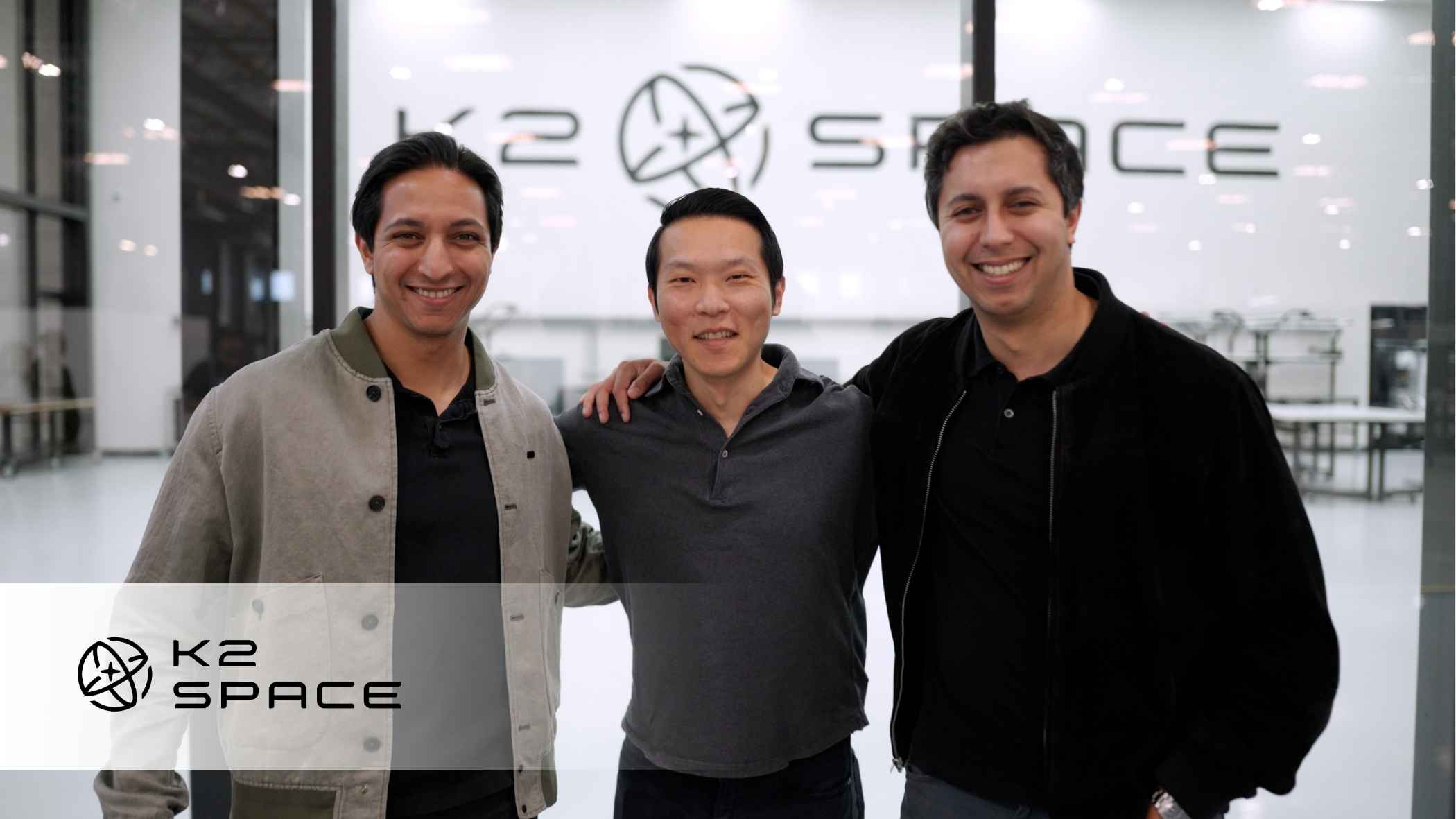



The first space age proved that humanity could reach beyond Earth. We believe the chapter ahead will be defined by what we build there. Today, we're announcing our partnership with K2 Space, co-leading its Series D to support the team building high-power satellite platforms for the next era of the space economy.
For more than half a century, access to space shaped everything that followed. Rockets were expensive, infrequent, and constrained in how much they could carry. Those realities shaped the satellites we built—and the ambitions of governments and commercial operators alike. Reusable rockets have begun to rewrite that equation. As launch becomes more affordable, more frequent, and capable of carrying far greater mass, entirely new possibilities have opened. The question is no longer how we get to orbit, but what we can do once we're there.
Now, one of the defining constraints is power.
K2 was founded in 2022 around a simple but consequential insight: in orbit, power is a key determinant of capability. It governs how much a spacecraft can sense, process, communicate, host, and maneuver. An order of magnitude more power doesn't simply make a satellite better—it helps enable an entirely different class of missions. K2’s 20kW Mega-class platform is designed to deliver expanded capabilities at a fraction of traditional cost, with a production model built to scale.
The Economics of Orbit
Demand for more capable spacecraft is accelerating across both national security and commercial markets.
Space has become a contested domain, and the United States and its allies are re-architecting their presence in orbit around resilience, speed, and distributed capability. Missions spanning missile warning, secure communications, navigation, and space-based defense require architectures that legacy programs were never designed to deliver quickly or affordably. Commercial demand is evolving in parallel. Operators increasingly need spacecraft capable of processing, relaying, and transmitting far more data than previous generations of satellites were built to handle.
Yet supply has struggled to keep pace. Incumbent manufacturers generally continue to build spacecraft on long development cycles at extraordinary cost. Many newer entrants have focused on smaller, lower-power satellites in low Earth orbit.
K2 is taking a different approach. As co-founder Karan Kunjur puts it, K2 set out to build satellites "so big that the smallest one we ever make would be as large as the largest satellites ever flown." We believe the next generation of space infrastructure demands this combination of high power, large payload capacity, rapid manufacturing, and dramatically lower cost.
Mission Ready
In March 2026, K2's Gravitas mission successfully placed its first satellite in orbit, deployed its 40-meter solar arrays, fired its 20kW electric thruster in space, and brought 12 commercial and national security payloads online. In an industry long defined by ambitious promises and slipping timelines, watching this team deliver on its first mission told us everything we needed to see.
In the commercial sector, SES selected K2 to build an up to 100-satellite medium Earth orbit constellation, one of the largest commercial satellite manufacturing awards ever earned by a startup. On the national security side, K2 has partnered with our portfolio company Anduril on the Golden Dome space-based interceptor missile defense program while securing additional contracts across Space Force and Intelligence Community customers.
A Gravitational Pull On Talent
Great hardware companies are ultimately built by exceptional engineering teams, and we believe K2 has become a gravitational force pulling in some of the industry's top talent. Each major subsystem—across propulsion, structures, avionics, manufacturing, and program execution—is led by someone with the “right stuff,” from the engineer who designed the original Starlink thruster to the leaders who built flight-critical systems for Dragon and Starshield.
What impressed us just as much was the culture Karan, Neel, and the team have built. Their ambition is unmistakable, but so is their discipline. Flight hardware leaves no room for shortcuts, and K2 pairs bold goals with the rigor required to achieve them. That combination is poised to attract some of the best and brightest—and can compound over time.
The Next Frontier
For ICONIQ, this marks a major milestone as we deepen our engagement in the space economy. It's a giant leap for us into a category we believe is critical to humanity's future. We're honored to support Karan, Neel, and the entire K2 Space team as they help power it. Ad astra!
Published:
July 30, 2026