

When we first partnered with Omni last year, we believed the semantic layer would become critical infrastructure for the enterprise to drive value from AI. A lot has changed since then; the world has largely caught up to the vision Colin, Jamie, Chris and the Omni team believed for a long time.
The pace of AI adoption across the enterprise has accelerated dramatically, and with it, the stakes around data accuracy have risen sharply. The question is no longer whether companies can access their data. AI has largely solved that. Any employee can now ask a complex business question in plain English and receive an answer in seconds. The question is whether they can trust it. Every business speaks its own language, and that language does not live in columns; it lives in context. "Closed deals" and "revenue" mean something different to each team in a company, and sometimes to each contributor within one. Without a governed layer of business logic to ground AI outputs, speed can become a liability: the faster you get an answer, the faster you can act on the wrong one.
What is missing is not more data or better models. It is a system that encodes how a business actually works. That shift, from access as the constraint to trust as the constraint, is exactly what Omni anticipated, and what they've been building for.
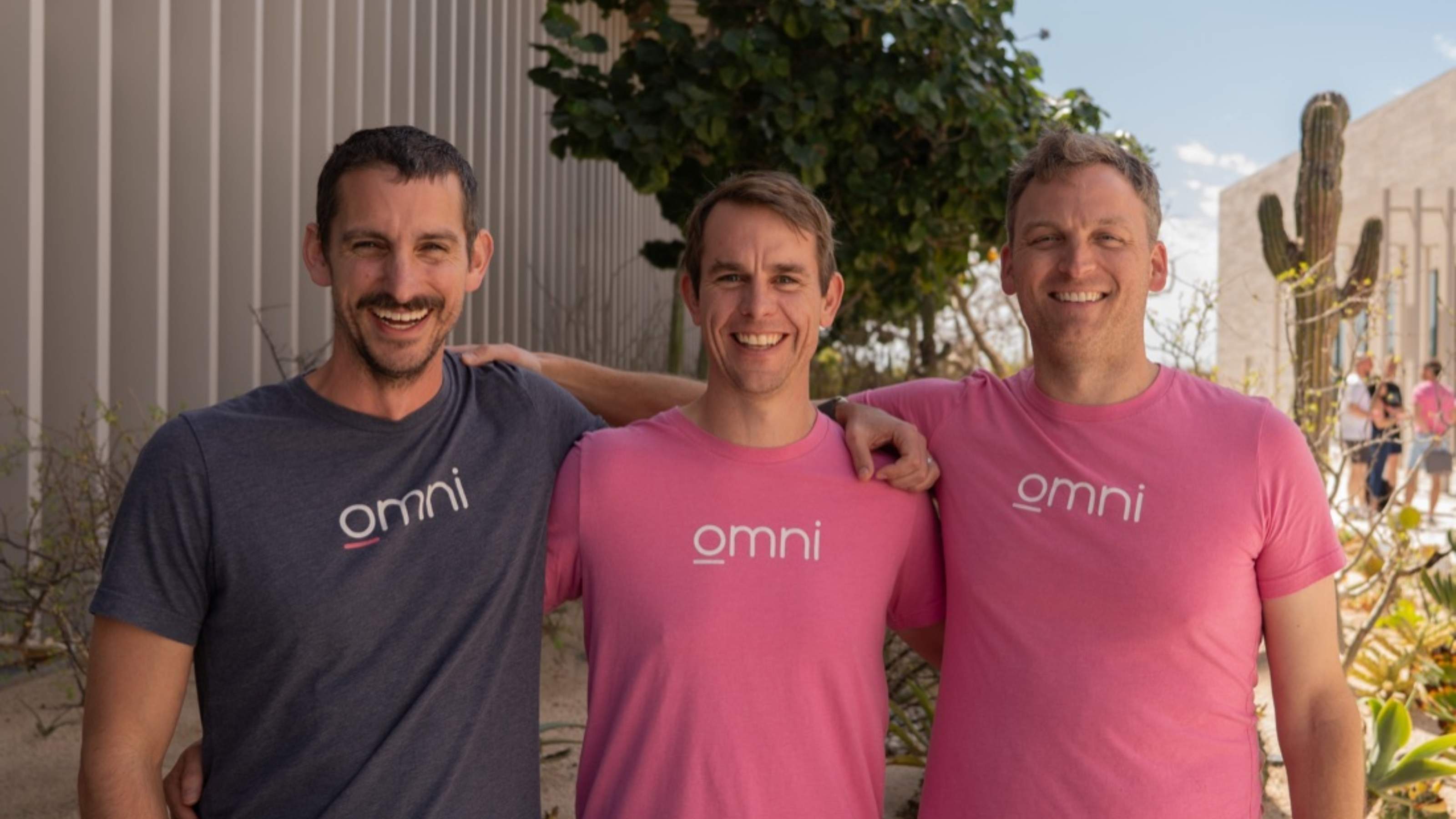
Today, we are proud to lead Omni's Series C, doubling down and deepening our partnership with co-founders Colin Zima, Jamie Davidson, and Chris Merrick.
When we led the Series B, we backed a thesis: that the semantic layer would become critical infrastructure in an AI driven world, and that Omni's team had the rare combination of experience and conviction to build it right.
Drawing on decades of hard-earned experience building data and BI products at Looker, Google, Stitch, and dbt, Colin, Jamie, and Chris recognized early that AI for data is fundamentally a language problem, not a modeling problem. Traditional tools forced people to learn the schema. AI inverts that logic: The system typically must learn how the business actually thinks. Omni's governed context graph encodes that understanding, turning AI from something merely responsive into something reliably correct and grounded in trusted business logic.
Since we led Omni’s Series B last year, the pace of execution has been remarkable. The team has continued to ship with focus and speed, enabled in enormous ways by AI, expanding both the depth of the platform and its accessibility across a wide range of users, significantly lowering the barrier to data access while maintaining the trust and accuracy that enterprise use cases demand. Importantly, this governed context layer extends beyond Omni's native interface. Users can query governed data directly from tools like Claude, ChatGPT, and Gemini, with each query inheriting the same business logic and permissions. Users stay in the tools they already rely on; the data stays governed by Omni. That architectural choice positions Omni as the semantic foundation not just for analytics, but for an emerging system of AI agents operating across the enterprise.
This product-driven shift is reflected in how customers are adopting Omni as the product experience we believe has gone from amazing to truly magical. The company has not only won over enterprises, but also is deeply expanding within them, evolving from initial adoption to company-wide deployment as teams beyond data and analytics unlock the ability to access trusted data more quickly. BambooHR, where we sit on the board, is a strong example of this pattern. The company used Omni to deploy AI analytics to more than 30,000 people in just four months, quickly growing to over 100,000 public users today. This expansion pattern reflects a broader pattern of adoption we are seeing emerge across Omni’s customer base looking to democratize data insights for their end customers and users.
Looking ahead, we believe the opportunity extends far beyond any single product category. Analytics for the AI era is no longer about building dashboards, it is about building shared understanding so that both humans and machines can operate from the same source of truth. In our view, the future of work will be shaped by seamless interaction with live, trusted data embedded across everyday workflows. Omni’s semantic layer helps open the gateway to that future, connecting AI to real business context in a way that is governed, consistent and built to scale.
We are proud to deepen our partnership with a team that has demonstrated a clarity of vision and relentless pace of execution. As AI adoption accelerates, there is growing urgency for a centralized, governed layer that connects data to decision-making. We believe Omni is uniquely positioned to meet this moment and form the foundation upon which enterprise AI depends.
We could not be more excited about what lies ahead for Omni. We encourage everyone to try it for themselves, it is truly magical!
Published:
April 23, 2026