

2026State of GTM

The GTM playbook is being rewritten in real time. In 2026, the companies we see pulling ahead aren't just growing faster – they're selling differently, pricing differently, and building leaner teams with AI embedded into every layer of the funnel. This report draws on data from 150+ B2B Software GTM leaders – spanning early to late-stage – to separate what's genuinely moving the needle from what's still hype.
The Rise of Hybrid Motions and Smarter Monetization
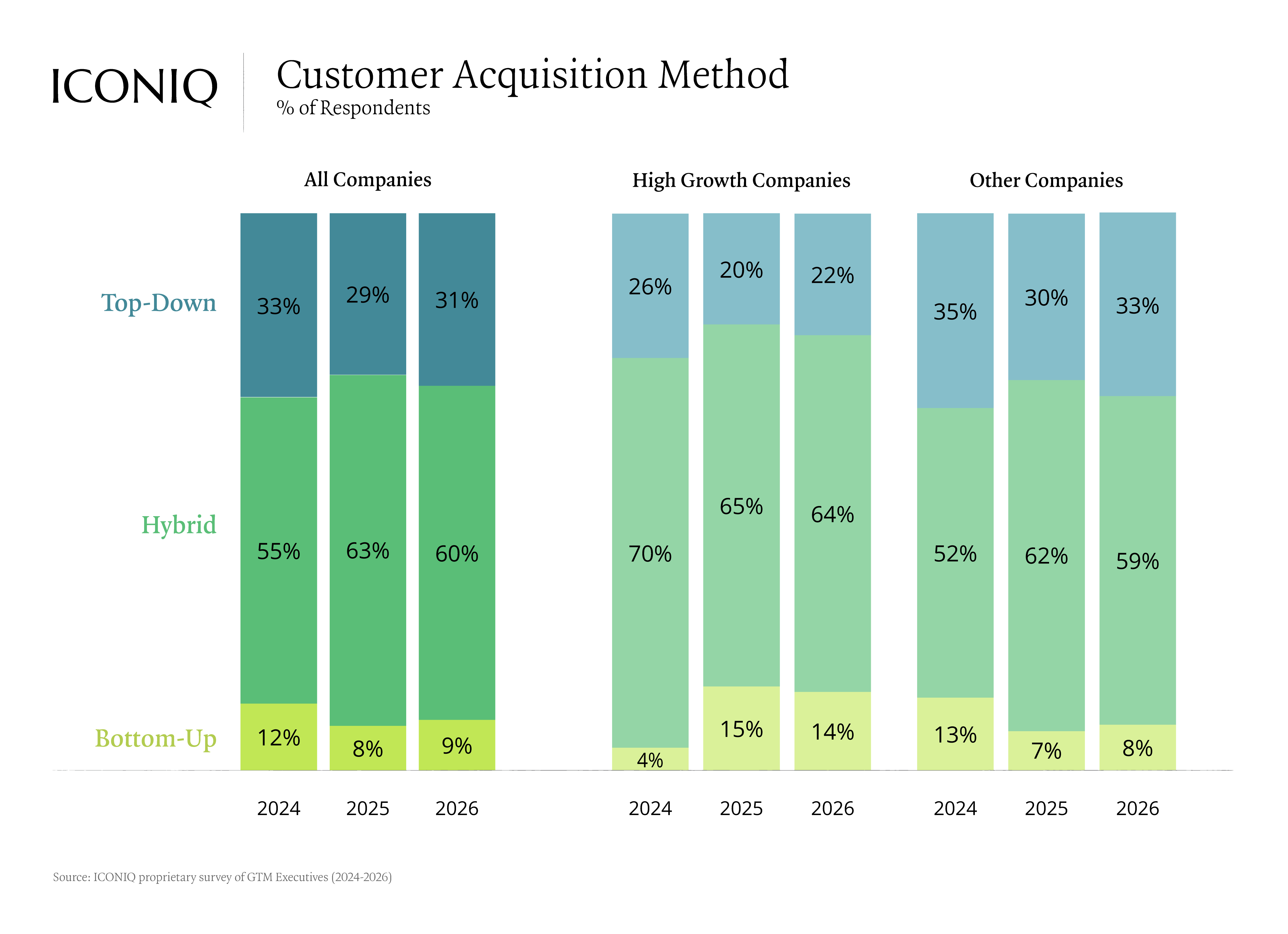
Hybrid is no longer a differentiator – it's the default. The most successful GTM organizations in 2026, based on our data, blend enterprise sales with bottom-up entry points, and build pricing models that reflect how customers actually want to buy.
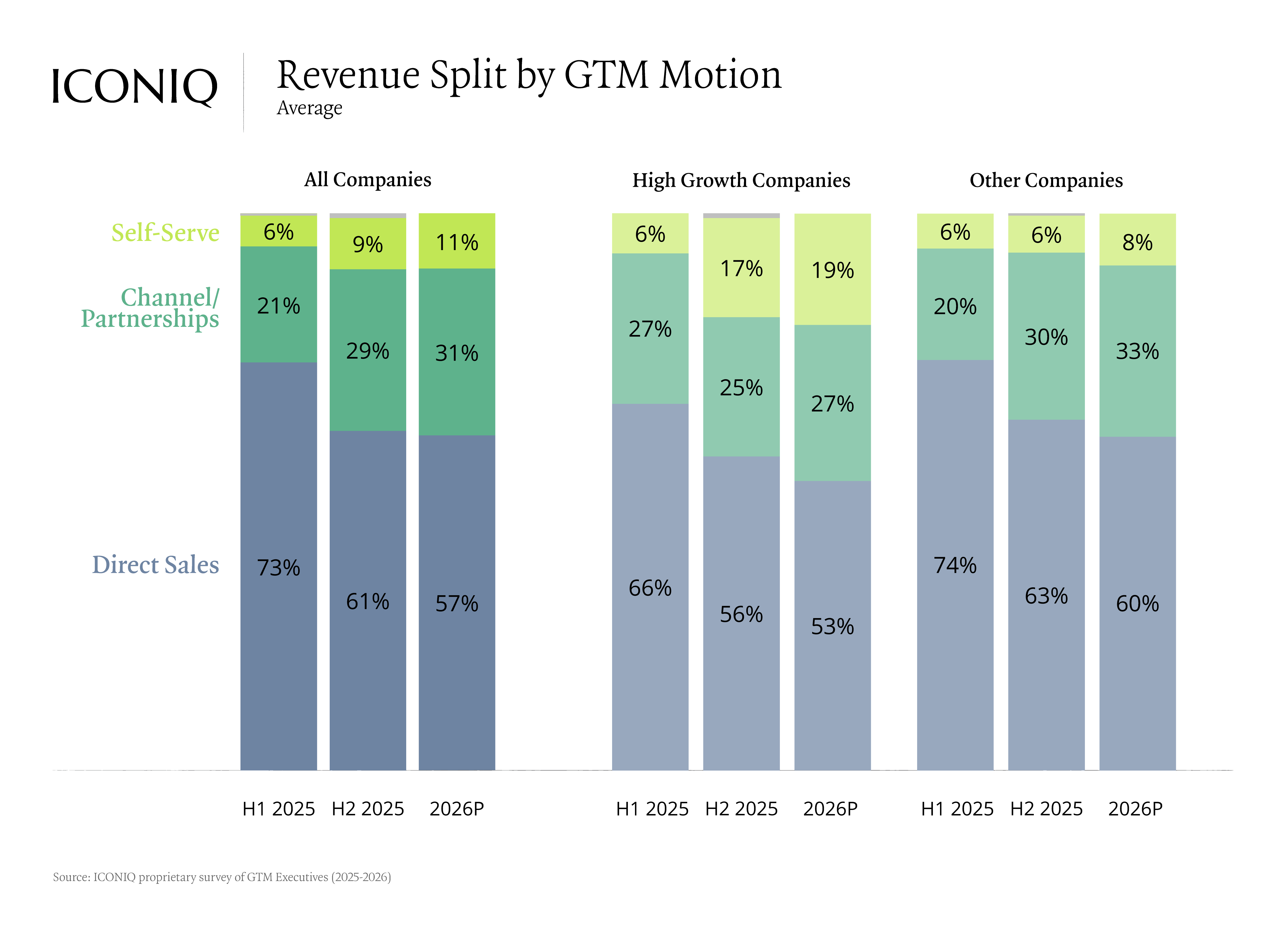
High-growth companies are leaning further into this shift. Where peers expect self-serve to account for roughly 10% of revenue in 2026, high-growth companies are projecting nearly double that – about 20% – a signal that bottom-up is becoming a serious revenue lever, not just a top-of-funnel experiment.
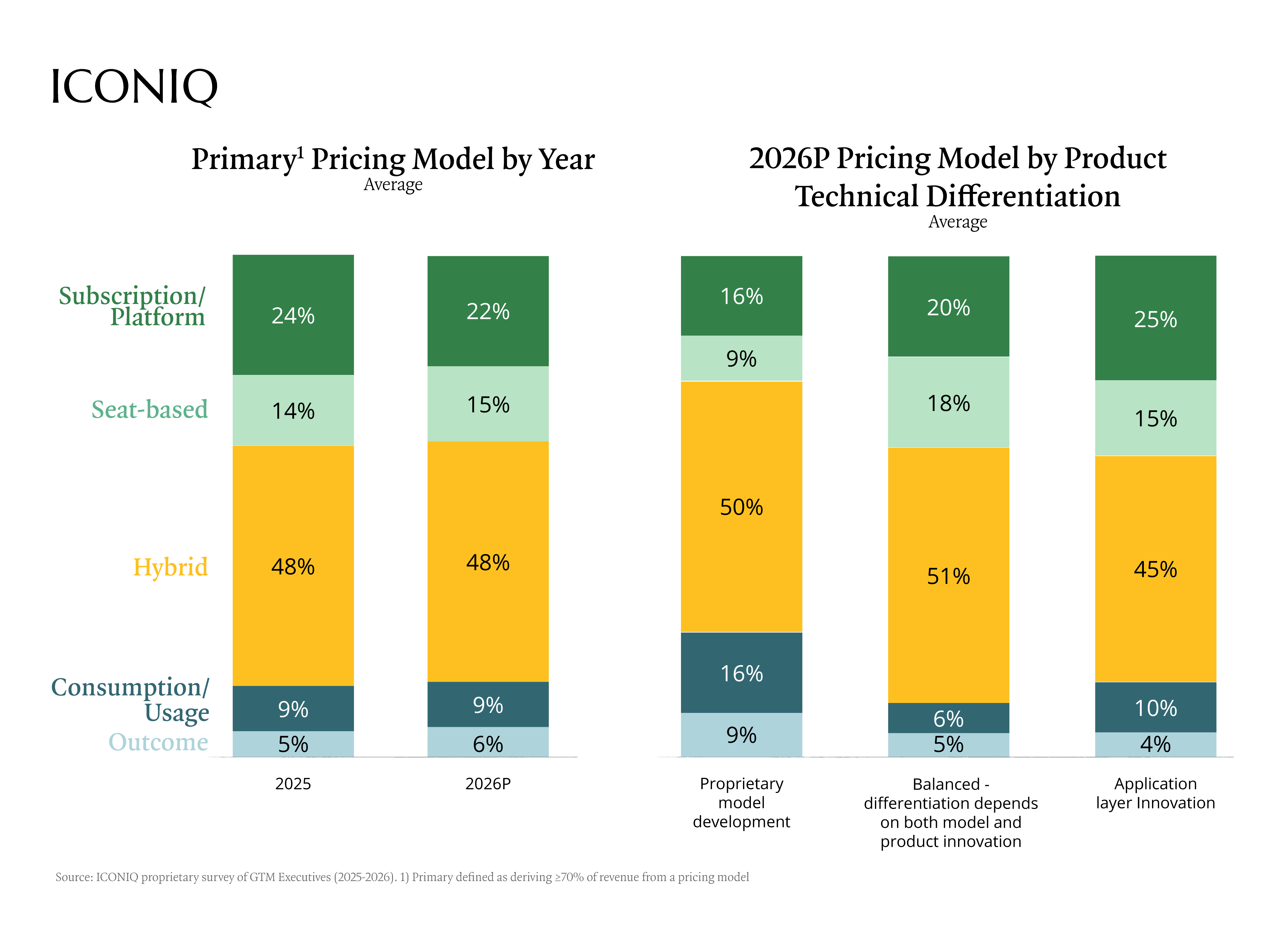
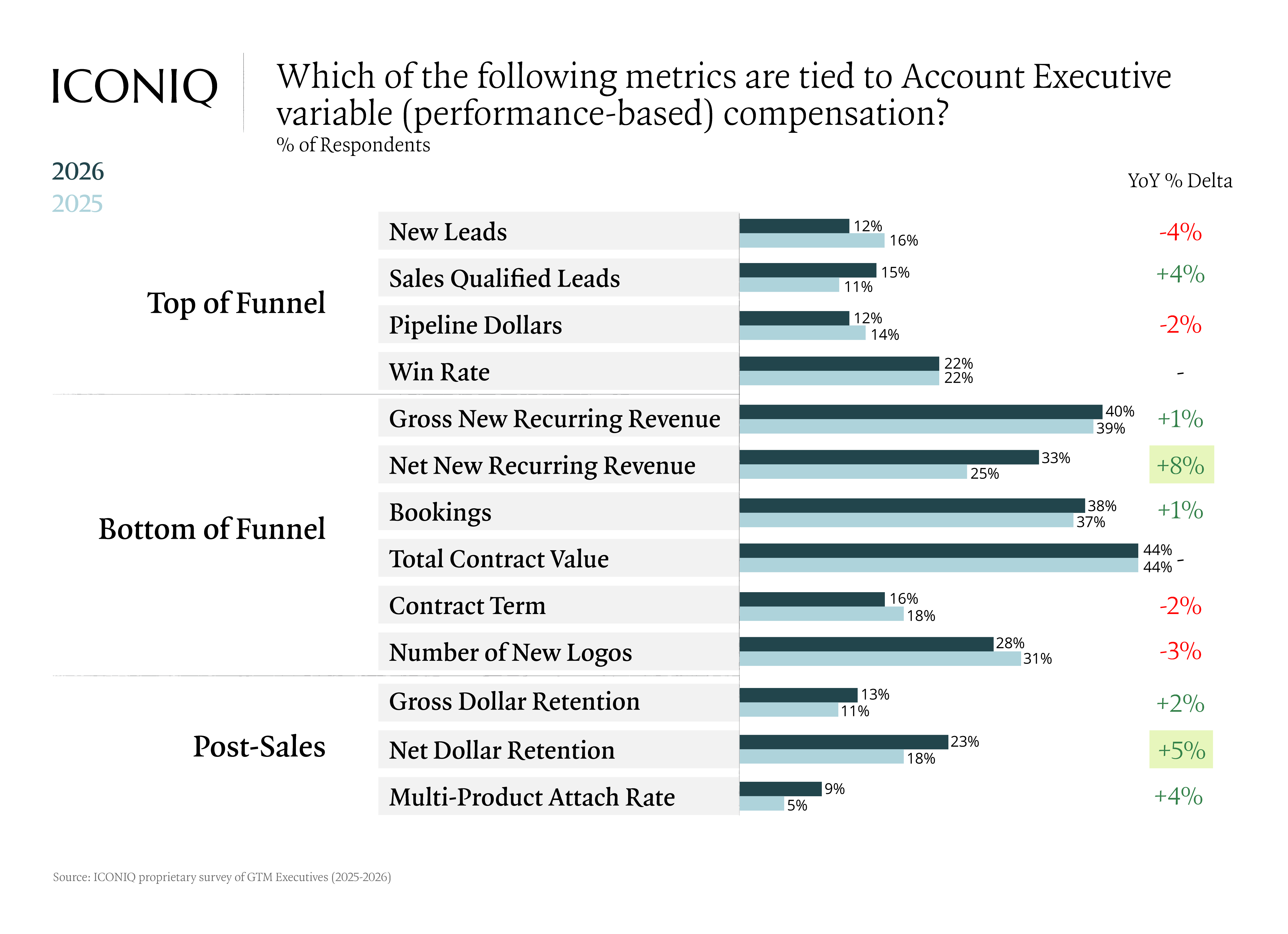
Monetization is also evolving in parallel. Nearly half of the companies (48%) operate with hybrid pricing models with compensation and usage-based pricing models gaining ground. Compensation structures are evolving to match. Companies now measure – and pay – Account Executives on Net Revenue and Net Dollar Retention alongside traditional metrics like Gross New ARR and TCV. The shift reflects a broader reorientation: long-term value creation is replacing one-time deal closure as the core GTM objective.
Key Takeaways:
- High-growth companies blend top-down and bottom-up acquisition, with a deliberate emphasis on bottom-up as a scalable growth lever
- Self-serve revenue is projected at about 20% for high-growth companies in 2026, versus roughly 10% for peers
- 48% of companies report hybrid as their primary pricing model, with consumption-based structures on the rise

.png)
Emerging Signs of Reacceleration
After a period of compressed growth and funnel inefficiency, the data points in a clearer direction: GTM health is improving, and the strongest companies are pulling further ahead.
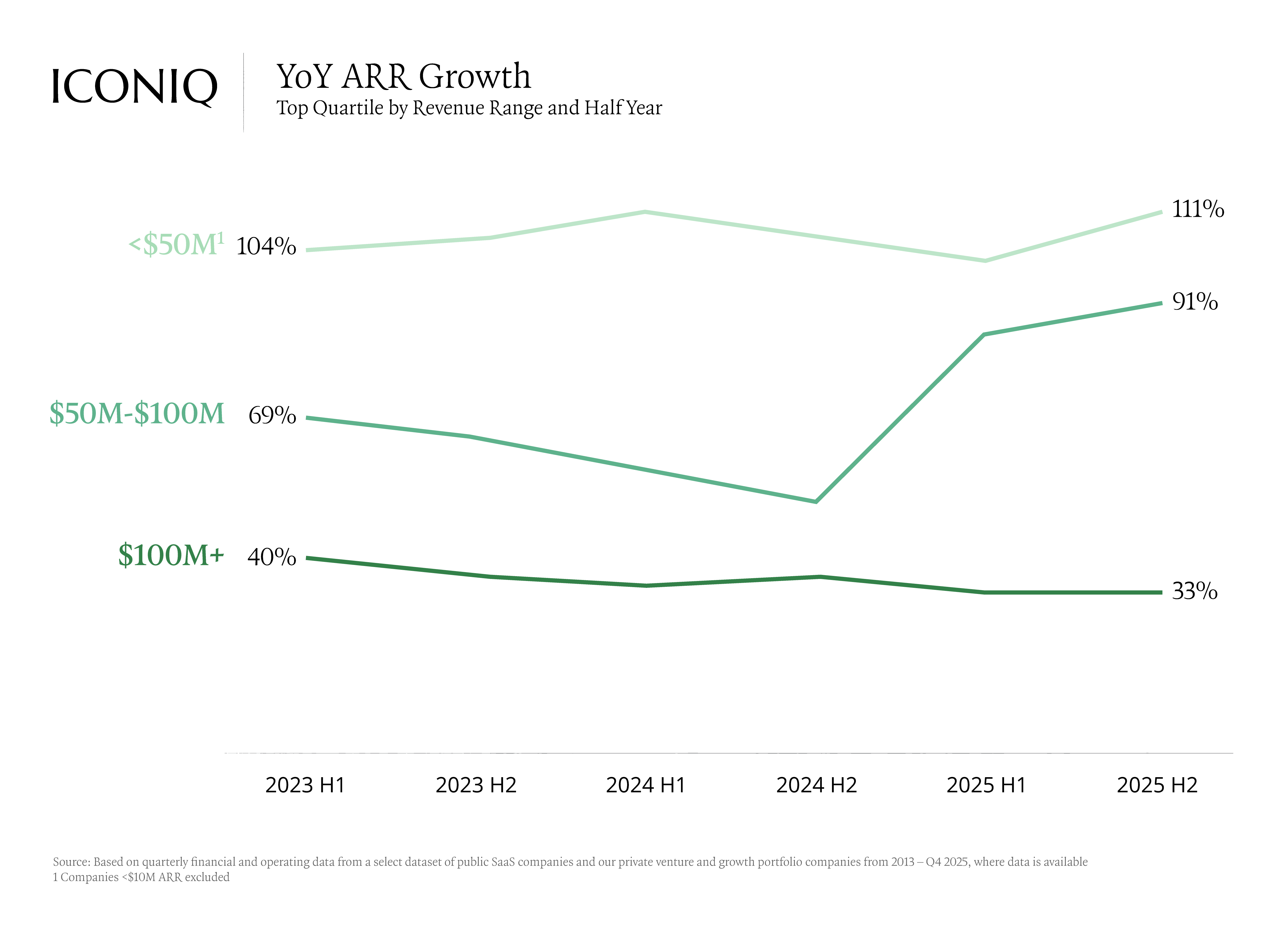
Top-quartile year-over-year (YoY) ARR growth is reaccelerating across most revenue bands – most notably among companies under <$100M, where momentum appears strongest. High-growth companies fuel this by doubling down on sales and channel-generated pipeline, which accounts for 60-80% of their total pipeline versus 15-20% from marketing. In the current environment, direct seller-led motions are earning their keep.
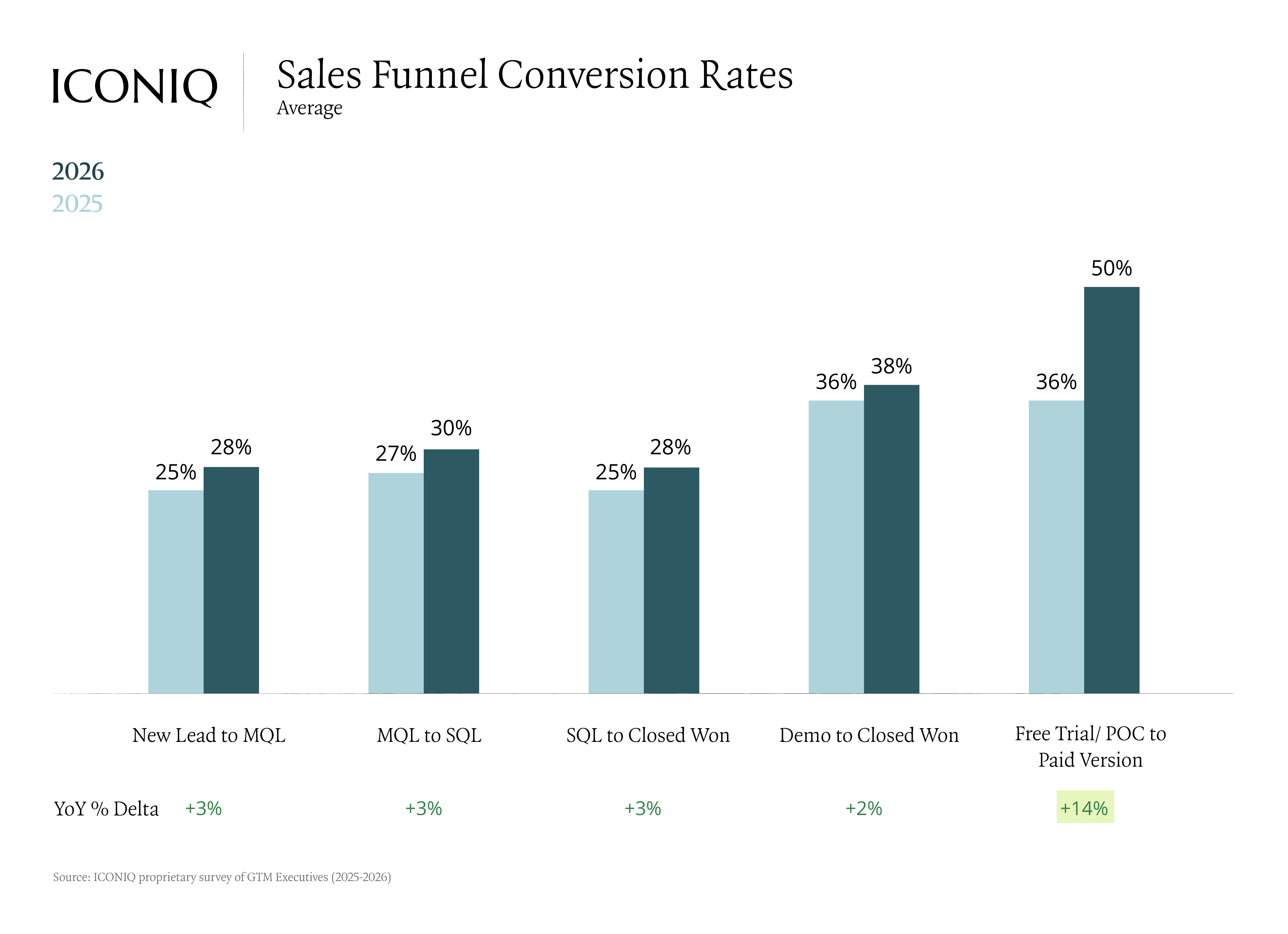
Funnel efficiency is up across the board, but the standout story is the free trial and proof-of-concept (POC) motion. Conversion rates for these paths have jumped to roughly 50% in 2026, up from about 36% in 2025 – outperforming traditional SQL and demo paths which convert at 30–40%. Companies investing in structured POC support, particularly at higher ACVs, are seeing the payoff.
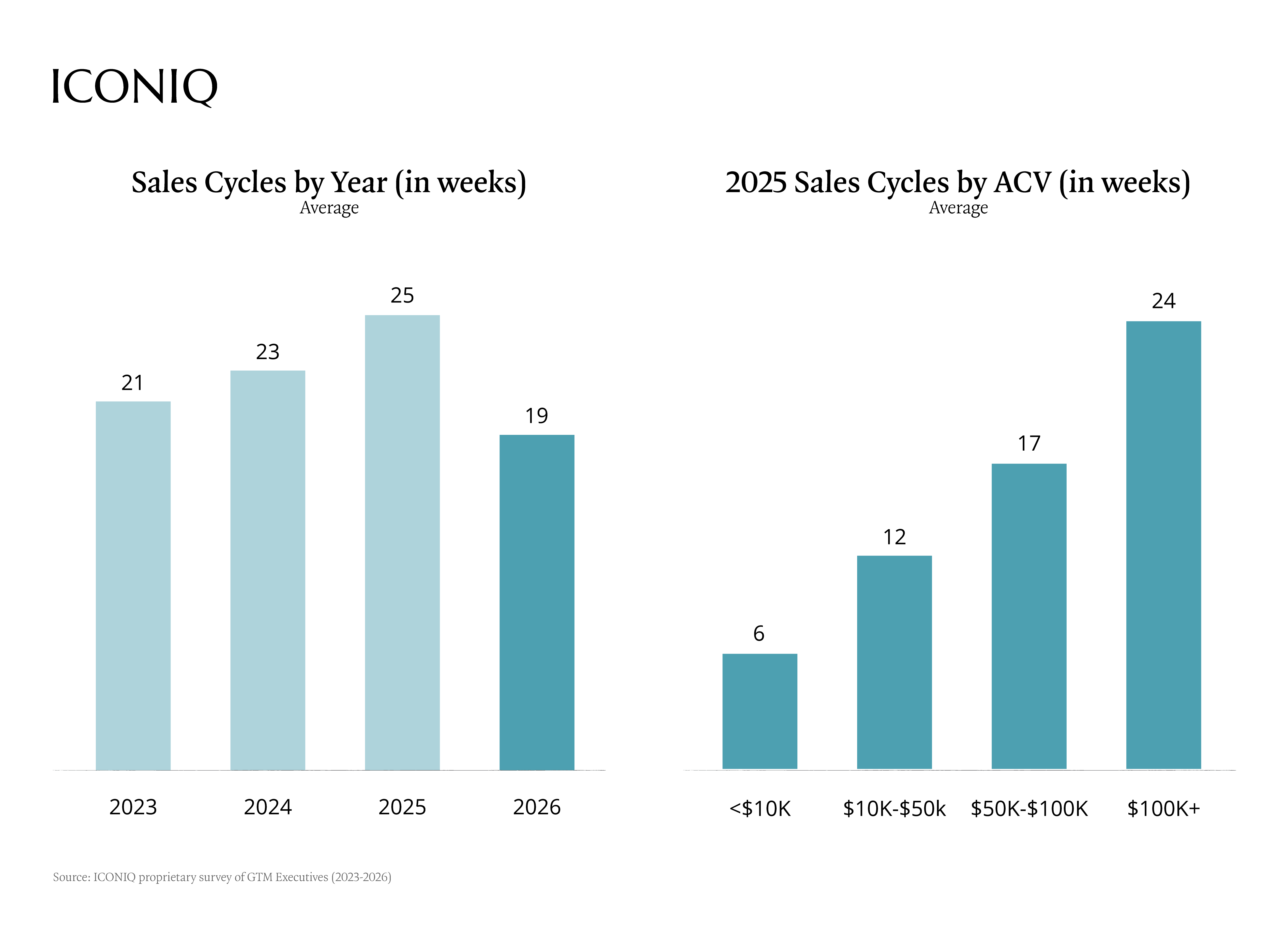
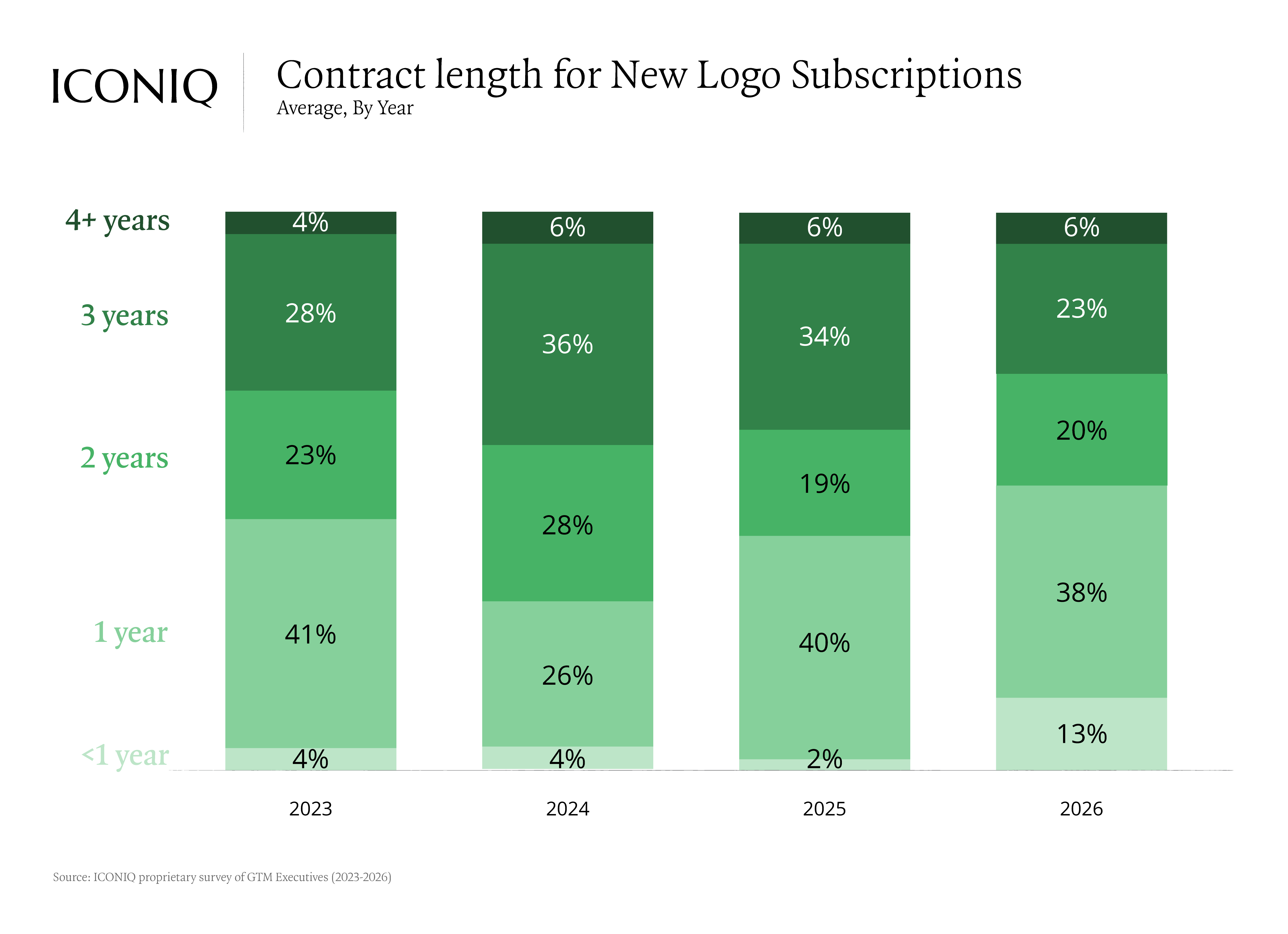
Sales cycles have shortened by approximately six weeks – a meaningful operational gain. The catch: this compression is happening alongside a notable shift toward shorter contract durations. Customers are signing faster, but committing to less. Sub-one-year terms are on the rise, driven by buyer demand for flexibility in a fast-moving AI market where multi-year commitments feel like a gamble.
Key Takeaways:
- Top-quartile ARR growth is trending upward, with the sharpest acceleration among under $100M companies
- Free trial and POC conversion has climbed to roughly 50%, up 14 points year-over-year
- Sales cycles are ~6 weeks shorter, but contract durations are also compressing – a combination that puts new pressure on post-sales teams
AI Implementation: Driving GTM Efficiency and Productivity
AI adoption is no longer the story – how companies embed it is. And the gap between deep adopters and everyone else is now showing up in the numbers.
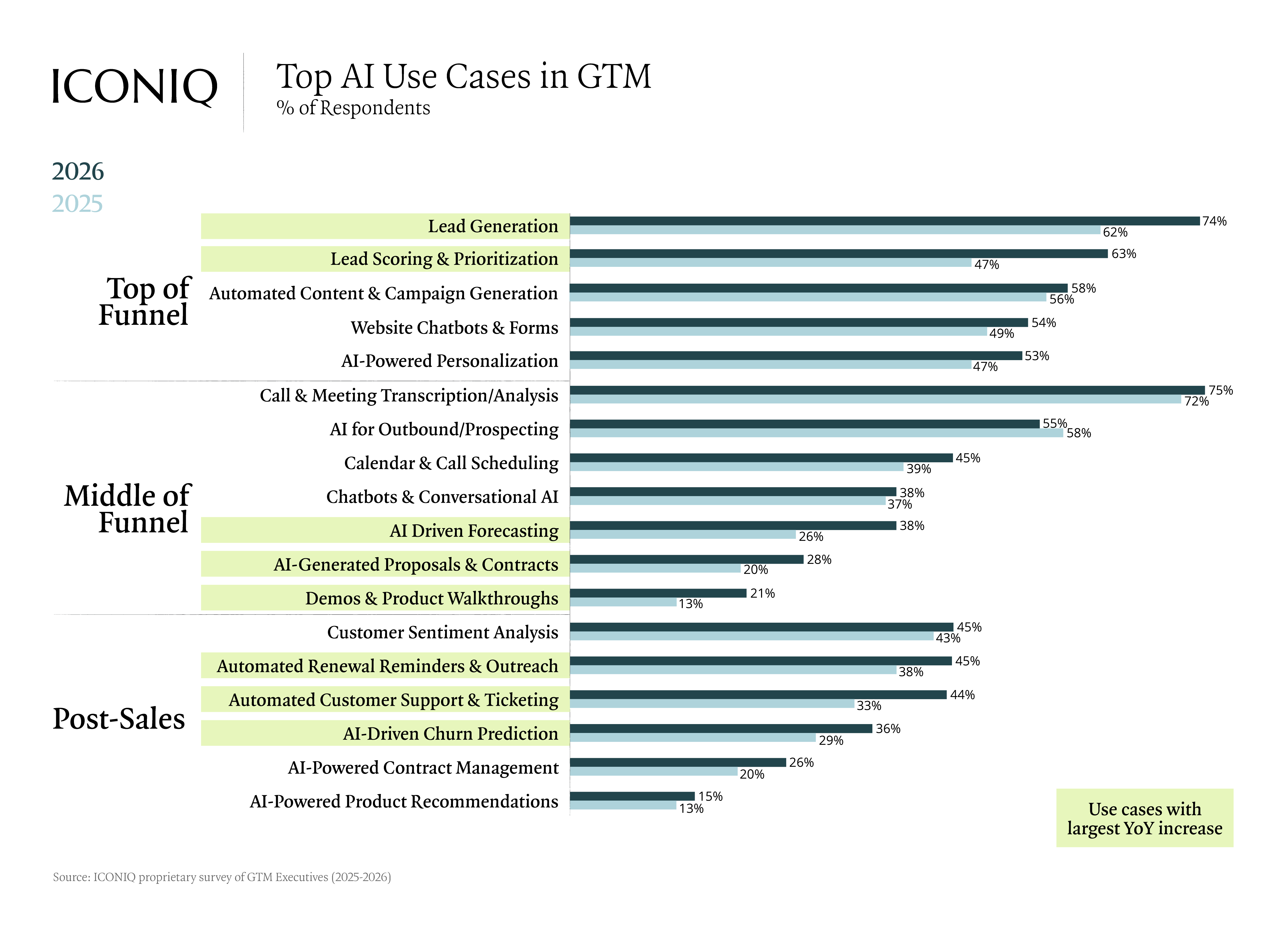
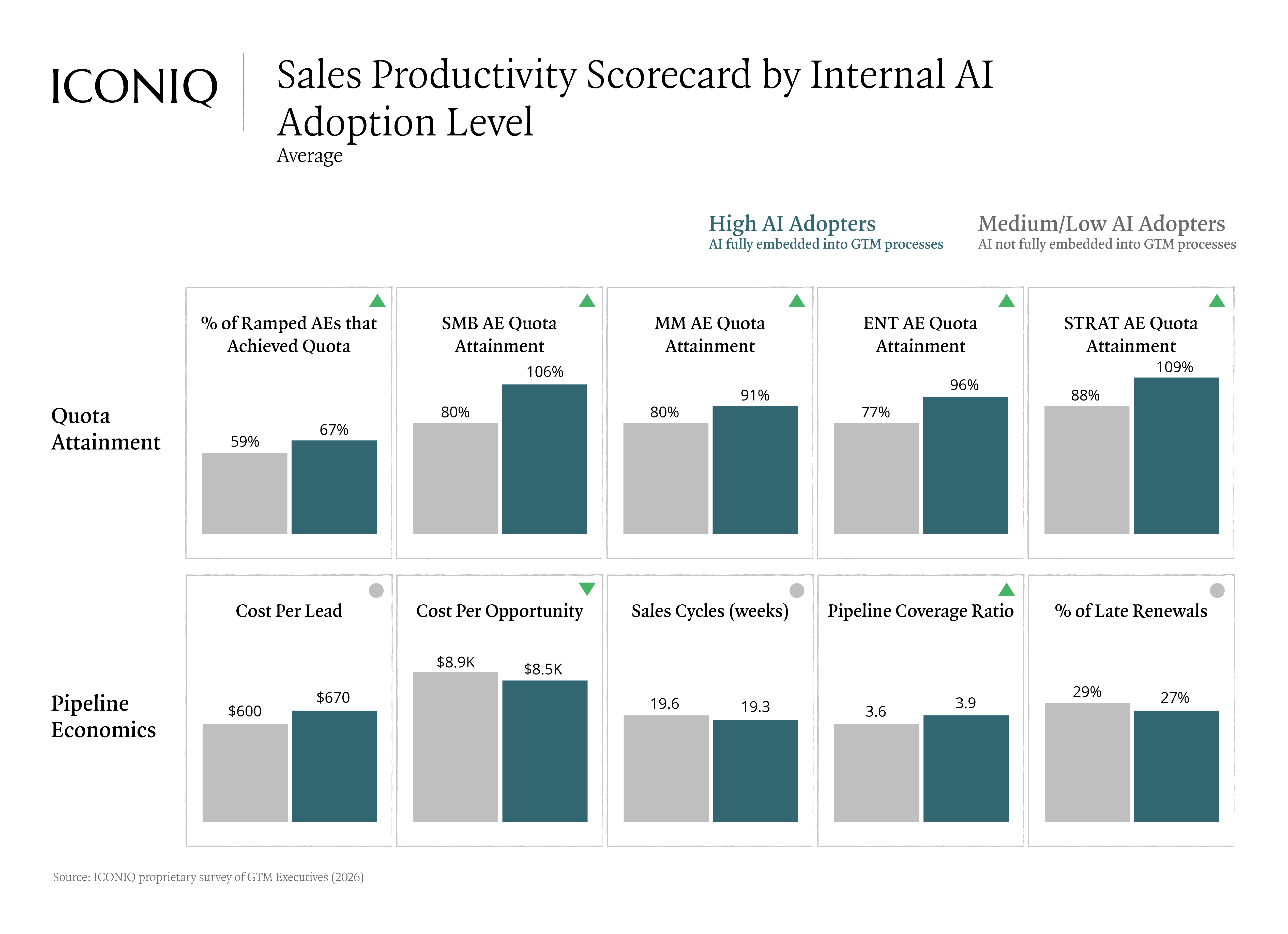
Companies with deeper AI integration are outperforming peers across funnel metrics, quota attainment, and team efficiency. The gains are most visible at the top of the funnel, where AI-influenced pipeline generation is driving meaningfully higher lead-to-MQL and MQL-to-SQL conversion rates– up 11% and 8%, respectively. The impact on active deal cycles is more modest for now, but the pipeline quality improvements are real and compounding.
The organizational implications are becoming clearer too. High AI adopters run leaner GTM teams at every revenue band, suggesting that AI is beginning to drive genuine leverage rather than just incremental productivity. The same revenue is being generated with fewer people, which changes the unit economics of growth in ways that will increasingly separate high-growth companies from the rest.
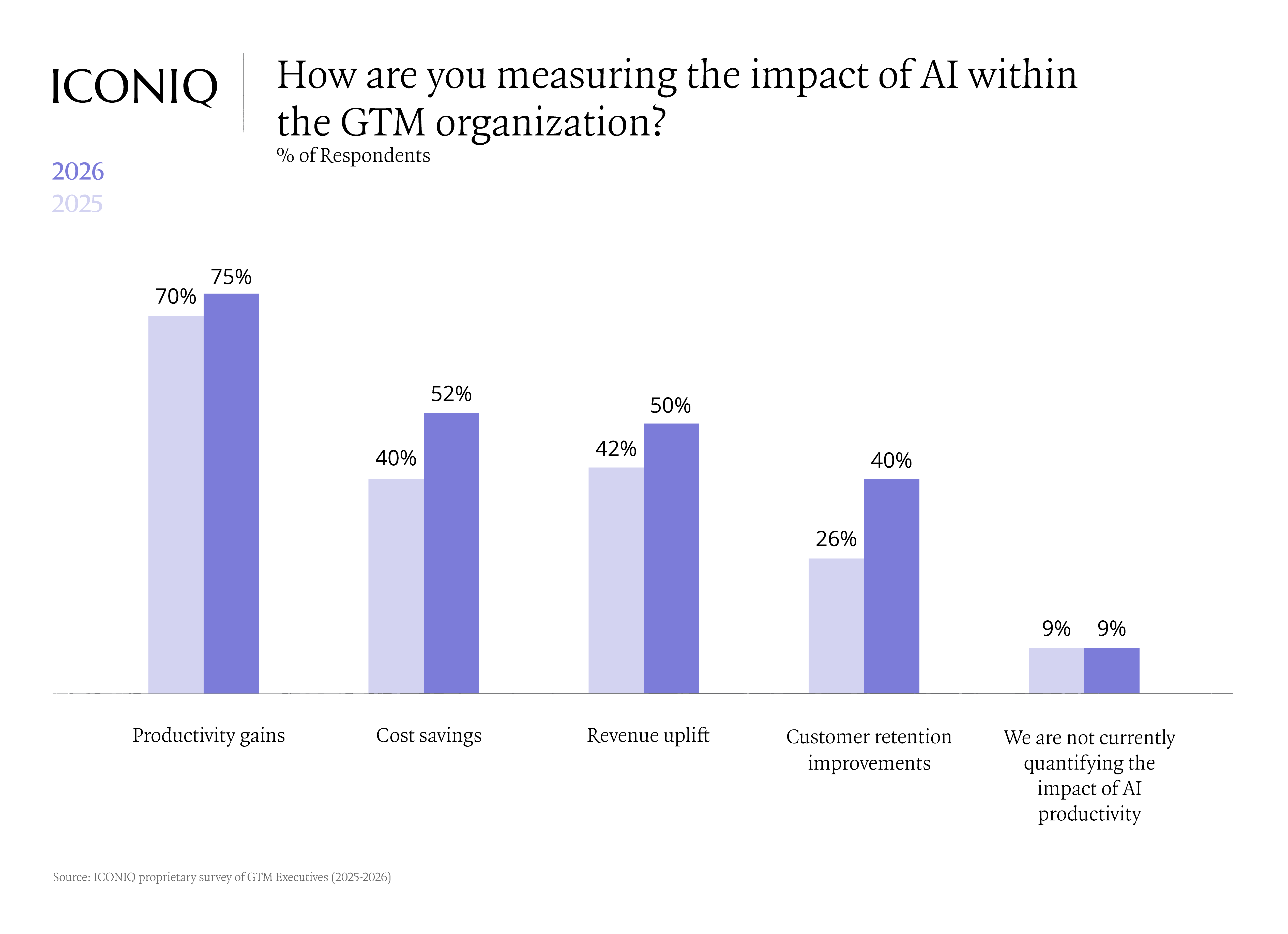
Perhaps most telling is how companies are measuring AI's ROI. Productivity gains remain the most common benchmark, but customer retention metrics are rising fast as a measurement framework. As AE compensation shifts toward NRR and NDR, and as consumption pricing introduces more revenue variability, the definition of AI success is converging with the definition of GTM success: sustainable, retained revenue. Companies that recognize this convergence early are the ones building durable advantages – not just faster funnels.
Key Takeaways:
- AI is expanding beyond top-of-funnel into forecasting, renewal outreach, and customer support – with the largest year-over-year adoption gains in mid-funnel and post-sales functions
- Higher AI adopters show stronger AE quota attainment across every segment – SMB, mid-market, enterprise, and strategic
- AI ROI is increasingly being measured against retention and net revenue metrics, not just cost savings or productivity
As AI reshapes the go-to-market landscape, we believe companies that embrace AI-driven strategies and operations will be best positioned for accelerated growth and efficiency gains. Staying agile and proactively addressing AI integration challenges can differentiate market leaders from followers, making 2025 a pivotal year for GTM innovation and transformation.
Disclaimer
The views expressed in this presentation are those of ICONIQ Venture & Growth ("ICONIQ" or the "firm"), are the result of proprietary research, may be subjective, and may not be relied upon in making an investment decision.
This presentation is for general information purposes only and does not constitute investment advice. This presentation must not be relied upon in connection with any investment decision. The information in this presentation is not intended to and does not constitute financial, accounting, tax, legal, investment, consulting or other professional advice or services. Nothing in this presentation is or should be construed as an offer, invitation or solicitation to engage in any investment activity or transaction, including an offer to sell or a solicitation of an offer to buy any securities which should only be made pursuant to definitive offering documents and subscription agreements, including without limitation, any investment fund or investment product referenced herein.
Any reproduction or distribution of this presentation in whole or in part, or the disclosure of any of its contents, without the prior consent of ICONIQ, is strictly unauthorized.
This presentation may contain forward-looking statements based on current plans, estimates and projections. The recipient of this presentation ("you") are cautioned that a number of important factors could cause actual results or outcomes to differ materially from those expressed in, or implied by, the forward-looking statements. The numbers, figures and case studies included in this presentation have been included for purposes of illustration only, and no assurance can be given that the actual results of ICONIQ or any of its partners and affiliates will correspond with the results contemplated in the presentation. No information is contained herein with respect to conflicts of interest, which may be significant. The portfolio companies and other parties mentioned herein may reflect a selective list of the prior investments made by ICONIQ.
Certain of the economic and market information contained herein may have been obtained from published sources and/or prepared by other parties. While such sources are believed to be reliable, none of ICONIQ or any of its affiliates and partners, employees and representatives assume any responsibility for the accuracy of such information.
All of the information in the presentation is presented as of the date made available to you (except as otherwise specified), and is subject to change without notice, and may not be current or may have changed (possibly materially) between the date made available to you and the date actually received or reviewed by you. ICONIQ assumes no obligation to update or otherwise revise any information, projections, forecasts or estimates contained in the presentation, including any revisions to reflect changes in economic or market conditions or other circumstances arising after the date the items were made available to you or to reflect the occurrence of unanticipated events.
For avoidance of doubt, ICONIQ is not acting as an adviser or fiduciary in any respect in connection with providing this presentation and no relationship shall arise between you and ICONIQ as a result of this presentation being made available to you.
ICONIQ is a diversified financial services firm and has direct client relationships with persons that may become limited partners of ICONIQ funds. Notwithstanding that a person may be referred to herein as a "client" of the firm, no limited partner of any fund will, in its capacity as such, be a client of ICONIQ. There can be no assurance that the investments made by any ICONIQ fund will be profitable or will equal the performance of prior investments made by persons described in this presentation.
Any information in this presentation is directed at, and intended for, only persons who are experienced institutional or professional investors (“professional investors”) as defined by applicable law and regulation. Any person that is not a professional investor is not an intended recipient of this presentation and the matters discussed herein.
ICONIQ is a trading name of certain ICONIQ Partners (UK) LLP. ICONIQ Partners (UK) LLP (Registration Number: 973080) is an appointed representative of Kroll Securities Ltd. (Registration Number: 466588) which is authorised and regulated by the Financial Conduct Authority. ICONIQ Partners (UK) LLP is a limited liability partnership whose members are ICONIQ Capital (UK) Ltd, Seth Pierrepont and Lou Thorne, and it is registered in England and Wales and has its registered office at 27 Soho Square, London W1D 3QR. ICONIQ Partners (UK) LLP acts as an adviser to ICONIQ Capital LLC
Unless otherwise indicated, the views expressed in this presentation are those of ICONIQ Venture and Growth (“ICONIQ" or the “Firm"), are the result of proprietary research, may be subjective, and may not be relied upon in making an investment decision. Information used in this presentation was obtained from numerous sources. Certain of these companies are portfolio companies of ICONIQ Venture and Growth. ICONIQ Venture and Growth does not make any representations or warranties as to the accuracy of the information obtained from these sources.
This presentation is for general information purposes only and does not constitute investment advice. This presentation must not be relied upon in connection with any investment decision. The information in this presentation is not intended to and does not constitute financial, accounting, tax, legal, investment, consulting or other professional advice or services. Nothing in this presentation is or should be construed as an offer, invitation or solicitation to engage in any investment activity or transaction, including an offer to sell or a solicitation of an offer to buy any securities which should only be made pursuant to definitive offering documents and subscription agreements, including without limitation, any investment fund or investment product referenced herein.
Any reproduction or distribution of this presentation in whole or in part, or the disclosure of any of its contents, without the prior consent of ICONIQ, is strictly unauthorized.
This presentation may contain forward-looking statements based on current plans, estimates and projections. The recipient of this presentation ("you") are cautioned that a number of important factors could cause actual results or outcomes to differ materially from those expressed in, or implied by, the forward-looking statements. The numbers, figures and case studies included in this presentation have been included for purposes of illustration only, and no assurance can be given that the actual results of ICONIQ or any of its partners and affiliates will correspond with the results contemplated in the presentation. No information is contained herein with respect to conflicts of interest, which may be significant. The portfolio companies and other parties mentioned herein may reflect a selective list of the prior investments made by ICONIQ.
Certain of the economic and market information contained herein may have been obtained from published sources and/or prepared by other parties. While such sources are believed to be reliable, none of ICONIQ or any of its affiliates and partners, employees and representatives assume any responsibility for the accuracy of such information.
All of the information in the presentation is presented as of the date made available to you (except as otherwise specified), and is subject to change without notice, and may not be current or may have changed (possibly materially) between the date made available to you and the date actually received or reviewed by you. ICONIQ assumes no obligation to update or otherwise revise any information, projections, forecasts or estimates contained in the presentation, including any revisions to reflect changes in economic or market conditions or other circumstances arising after the date the items were made available to you or to reflect the occurrence of unanticipated events. Numbers or amounts herein may increase or decrease as a result of currency fluctuations.
For avoidance of doubt, ICONIQ is not acting as an adviser or fiduciary in any respect in connection with providing this presentation and no relationship shall arise between you and ICONIQ as a result of this presentation being made available to you.
ICONIQ is a diversified financial services firm and has direct client relationships with persons that may become limited partners of ICONIQ funds. Notwithstanding that a person may be referred to herein as a "client" of the firm, no limited partner of any fund will, in its capacity as such, be a client of ICONIQ. There can be no assurance that the investments made by any ICONIQ fund will be profitable or will equal the performance of prior investments made by persons described in this presentation.
Any information in this presentation is directed at, and intended for, only persons who are experienced institutional or professional investors (“professional investors”) as defined by applicable law and regulation. Any person that is not a professional investor is not an intended recipient of this presentation and the matters discussed herein.
ICONIQ is a trading name of ICONIQ Partners (UK) LLP. ICONIQ Partners (UK) LLP (Registration Number: 973080) is an appointed representative of Kroll Securities Ltd. (Registration Number: 466588) which is authorised and regulated by the Financial Conduct Authority. ICONIQ Partners (UK) LLP is a limited liability partnership whose members are ICONIQ Capital (UK) Ltd, Seth Pierrepont and Lou Thorne, and it is registered in England and Wales and has its registered office at 27 Soho Square, London W1D 3QR. ICONIQ Partners (UK) LLP acts as an adviser to ICONIQ Capital LLC